EN
EN
I. Industry Demands: Why Industrial Users Are No Longer Satisfied with Merely "Functional" Equipment
Industrial environments are evolving, and so are equipment requirements. In the past, a winch was considered "adequate" simply if it could lift a heavy load. Today, however, merely being functional is far from enough.
Marine and Offshore Engineering
Equipment must not only withstand salt-spray corrosion but also maintain stable performance in confined spaces. If a marine winch fails at sea, repair costs can easily be several times the price of the equipment itself.
Construction Engineering
Winches on construction sites require frequent relocation and repetitive lifting, often completing hundreds of operational cycles a day. If the speed is insufficient, daily productivity suffers.
Mining Operations
Underground space is limited; if equipment fails, the entire work face may have to shut down. Reliability is not just a bonus—it is a strict requirement.
Warehousing and Logistics
Warehouse operations move fast, and staff turnover is high. If equipment is complex or difficult to use, training costs and the risk of operational errors rise significantly.
II. Customer Pain Points: Real-World Challenges
Issue 1: "Fragile" Equipment—Unable to Withstand Harsh Environments
Standard winches often begin to rust, accumulate dust, or suffer motor failures after just a few months on a construction site. Customers often say, "It's not a lack of maintenance; the environment is simply too harsh for the equipment to handle."
Issue 2: Slow Speeds—Project Schedules Drag On
A slow-speed winch might take two minutes for a single lift. Over the course of a day, hundreds of lifts add up to a difference of several hours. Since project deadlines are set by the client, slow equipment forces the team to work overtime.
Issue 3: Motor Overheating—Frequent Unplanned Stoppages
This is the most common complaint in high-frequency operation scenarios. "The motor gets so hot you can't even touch it; we have to stop and wait for it to cool down." Downtime spent waiting is wasted production time.
Issue 4: Complex Operation—Steep Learning Curve for Workers
Control panels are cluttered with buttons, requiring mode switches for different operating conditions. With high worker turnover, retraining is constantly required, preventing efficiency from reaching its full potential. III. Product Solution: How the AMWS Series Addresses These Issues
The design philosophy of the AMWS series is simple: first understand how users operate the equipment daily, then determine how the equipment should be built.
Core Specifications
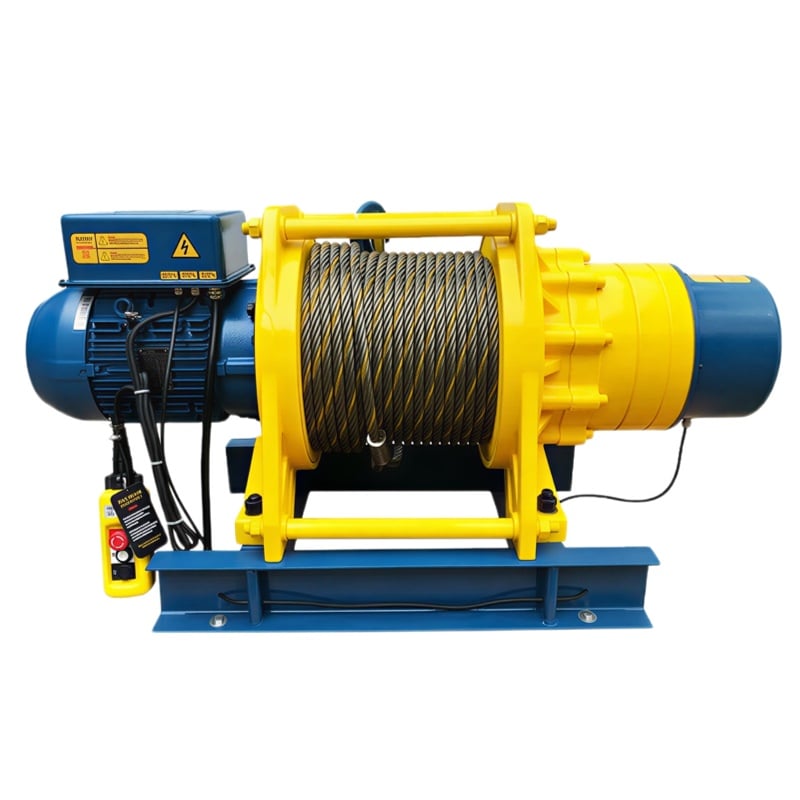
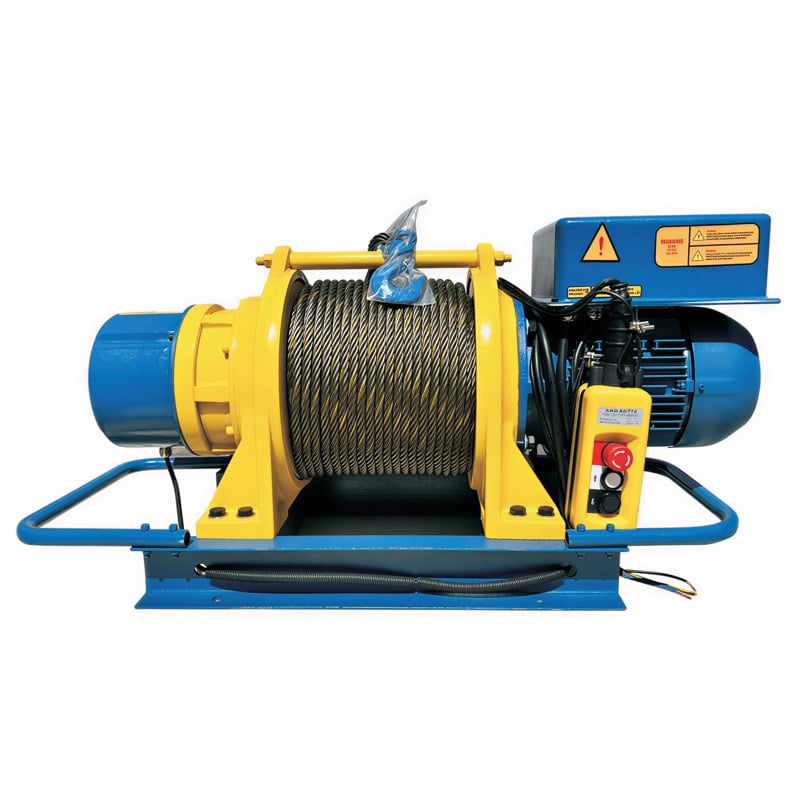
Parameter :AMWS Series Specifications
Duty Class :M5
Protection Rating :IP55
Motor :WEG brand motor; supports 24-hour continuous operation
Contactor :Schneider
Braking System : Electromagnetic brake
Drive System|:Planetary gear
Wire Rope Strength |:1770 MPa
Four Key Design Concepts
1. Durability: Not just a slogan, but a result of material quality
What does an IP55 protection rating mean? It means internal components are shielded from dust ingress and damage caused by water splashes. A 1770 MPa wire rope offers higher breaking strength and a longer service life compared to standard ropes of the same diameter. An M5 duty class indicates the unit is designed for high-frequency daily use, not just occasional operation.
2. High Speed: Not just a spec, but real value for project timelines
The WEG motor supports high-speed operation; combined with the efficient planetary gear drive, the AMWS series delivers lifting speeds far exceeding standard winches. This speed advantage translates not merely to being "a bit faster," but to tangible productivity gains—such as completing more lifting cycles per day.
3. Quiet Operation: Not a luxury, but a guarantee of continuous workflow
Overheating shutdowns are a primary cause of work interruptions. The stability of the WEG motor and the independent cooling fan design allow the AMWS to operate continuously in high-temperature environments without overheating—equipment that doesn't require "cooling-off" breaks is truly reliable.
4. Simplicity: Not crudeness, but exactly what operators need
The operating logic is clear and direct, with clearly defined button functions. New staff can master it without specialized training—a quick look is all it takes. Simplicity is, in itself, a form of efficiency.
IV. Application Value: The Impact of AMWS Across Industries
Marine and Offshore Engineering
Marine winches are often replaced only once every few years. Choosing AMWS means opting for long-term stability backed by IP55 protection and 1770 MPa wire ropes. With limited operational windows at sea, every trouble-free run translates into cost savings.
Construction Engineering
On construction sites, time is the single biggest cost factor. The AMWS's M5 duty rating means it can withstand frequent start-stop cycles without compromising its service life. Handling hundreds of lifts per day on a job site is no problem.
Mining Operations
In mining environments, the key requirement for equipment isn't just functionality, but longevity. Any breakdown entails massive costs in terms of both maintenance and downtime. The AMWS features a planetary gear drive and an M5 duty rating, specifically designed to ensure stable, long-term operation even in harsh conditions.
Warehousing and Logistics
Warehouses require frequent lifting and equipment movement, often involving a high turnover of operators. The AMWS features a simple, intuitive control logic, allowing new staff to get up to speed in just minutes. Its IP55 protection rating ensures that internal components remain clean, even in dusty warehouse environments.
V. Case Studies: Real Customer Feedback
Chilean Copper Mine Maintenance Workshop
An AMWS-1000 unit operated for six months without a single instance of unplanned downtime. The equipment manager's feedback was straightforward: "We were constantly repairing the hoists we used before; the AMWS is the only unit that lets us simply forget it's even there."
Brazilian Shipyard
The IP55 protection rating ensures stable performance in the humid environment of a shipyard. "We used other brands previously, and they started having issues after just three months. We've been using the AMWS for six months now, and everything is running perfectly."
Nantong Allman Industry Co.,Ltd. is a professional manufacturer specializing in the manufacturing and export of high-quality lifting&material handling equipment in China.
Room 1503, Building#2, No.#166, North Street, Nantong City, Jiangsu Province, China.
Copyright © Nantong Allman Industry Co.,Ltd. All Rights Reserved Privacy Policy Blog