EN
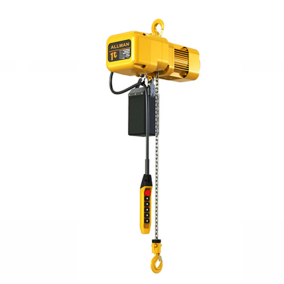
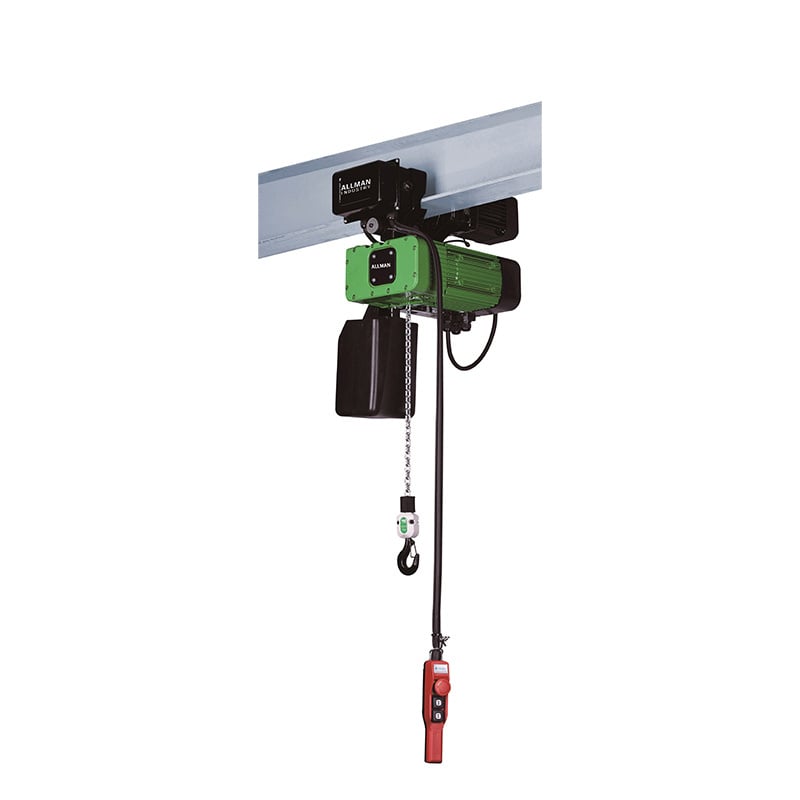
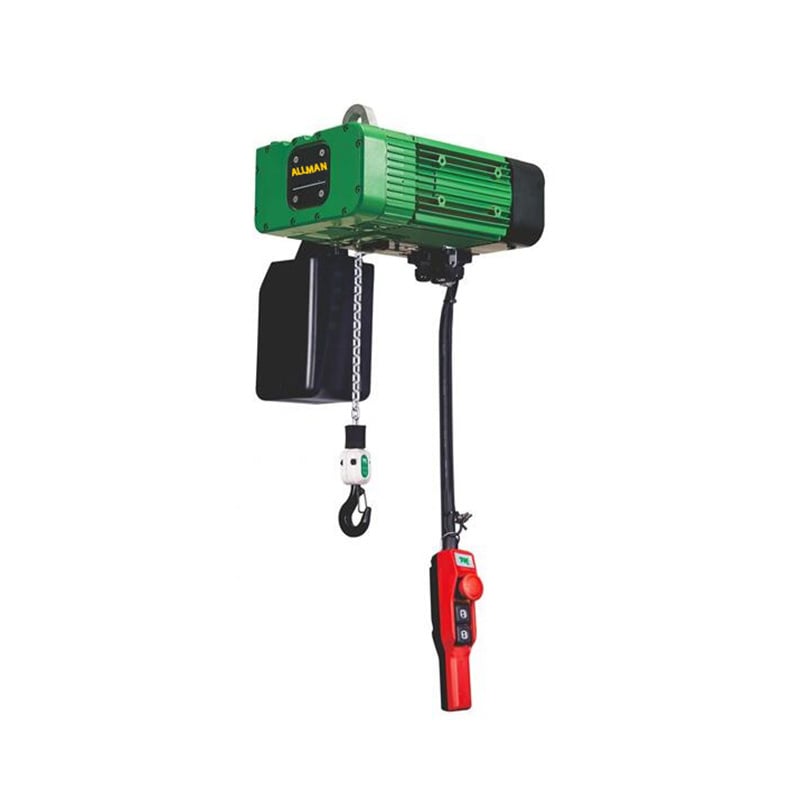
If you ask for a 2-tonne electric chain hoist, you are asking for one of four machines. Two of them lift in one chain fall, two in two; two are single speed, two are dual speed. They share a rated capacity and nothing else that matters at the point of use.
Here are all four, as published:
| Model | Speed | Motor | Falls | Load chain | Net weight | Dimension H |
| AMEH02-01S | 6.6 m/min | 3.0 kW | 1 | φ10.0 mm | 161 kg | 770 mm |
| AMEH02-02S | 3.3 m/min | 1.5 kW | 2 | φ7.1 mm | 123 kg | 815 mm |
| AMEH02-01D | 6.9 / 2.3 m/min | 3.0 / 1.0 kW | 1 | φ10.0 mm | 171 kg | 770 mm |
| AMEH02-02D | 3.3 / 1.1 m/min | 3.0 / 1.0 kW | 2 | φ7.1 mm | 147 kg | 815 mm |
The heaviest 2-tonne machine is 171 kg. The lightest is 123 kg. That is a 48 kg spread — 39 % of the lightest — under one capacity figure.
1. First decision: one fall or two
A single-fall hoist runs one chain straight from the body to the hook. Two falls runs the chain down, around a sheave in a travelling bottom block, and back up. Two parts of a smaller chain then carry what one part of a larger chain carried.
The single-speed pair shows the trade with unusual clarity:
Speed halves exactly: 6.6 → 3.3 m/min;
Motor power halves exactly: 3.0 → 1.5 kW;
Weight drops 38 kg: 161 → 123 kg;
Chain drops a size: φ10.0 → φ7.1;
Height rises 45 mm: 770 → 815 mm, because the bottom block has to exist.
Same capacity, same lifting job, and the machine is a quarter lighter, half as fast, and built on smaller chain. The 45 mm is the quiet cost: on a ceiling-critical installation it can rule out the two-fall build before speed gets a vote.
2. Second decision: single or dual speed
Dual speed adds a creep speed roughly 3:1 below the main speed — 6.9/2.3 on the single-fall build, 3.3/1.1 on the two-fall. The main speed is not reduced to get it: 6.9 m/min against 6.6 on the single-speed equivalent.
What dual speed costs is weight, and the cost is not the same on both builds:
| Upgrade | Weight change |
| Single-fall, single → dual speed | 161 → 171 kg (+10 kg) |
| Two-fall, single → dual speed | 123 → 147 kg (+24 kg) |
Note also the motor rating on the dual-speed builds: 3.0 / 1.0 kW on both, where the single-speed pair ran 3.0 and 1.5. The two-fall dual-speed machine therefore carries a bigger motor than its single-speed equivalent — which is why its weight penalty is more than double.
Dual speed is worth specifying where the load has to arrive somewhere specific: mould handling, assembly, setting a part onto a fixture. On pure transfer work, the 6.6 m/min single-speed build is the same 2 tonnes for less money and less weight.
3. Chain size does not identify capacity
Two φ10.0 machines sit next to each other in the table, and they are not the same purchase:
| Model | Capacity | Speed | Motor | Net weight |
| AMEH1.5-01S | 1.5 t | 8.8 m/min | 3.0 kW | 145 kg |
| AMEH02-01S | 2 t | 6.6 m/min | 3.0 kW | 161 kg |
Same chain, same motor rating, same 770 mm height — but the 1.5 ton lifts faster (8.8 against 6.6 m/min) and weighs 16 kg less. Chain diameter does not set capacity, and capacity does not set speed. Only the model code does.
There is a second version of the same trap: the 2 ton two-fall build uses φ7.1, the same chain as the 1-tonne machine (103 kg, 6.6 m/min, 650 mm). Anyone ordering spare chain "for our 2-tonne hoist" needs the model code, not the tonnage.
And one that surprises most buyers: the 2-tonne two-fall machine (123 kg) is lighter than the 1.5-tonne single-fall machine (145 kg). A smaller machine is not automatically the lighter one — fall count decides that.
The number that grows with every metre of lift
Chain in the system is falls × lifting height. At 6 m of lift:
Twice the chain, twice the weight hanging in the container, twice the volume. Chain containers are sized for a volume, which is why the standard canvas container is adequate for normal heights and a steel container is offered once the lifting height exceeds what the standard container holds. It is also why an undersized container produces the familiar fault of chain stacking and the limit switch tripping early.
The maintenance arithmetic follows: a two-fall machine at 6 m gives you 12 m of chain to inspect — pitch elongation, diameter loss, nicks, weld spatter, twist, rust — every time, for the life of the hoist.
4. Choosing between the four
| If your cycle is… | Specify |
| Transfer: pick up, lift, travel, set down | Single speed, one fall — 6.6 m/min, 161 kg |
| Positioning: load must stop within centimetres | Dual speed, one fall — 6.9 / 2.3 m/min, 171 kg |
| Low ceiling, or minimum height above the hook matters | Single speed, one fall — H 770 mm |
| Lightest machine for the capacity, manual handling of the unit | Single speed, two falls — 123 kg |
| Positioning and lightest possible | Dual speed, two falls — 3.3 / 1.1 m/min, 147 kg |
5. What to send for a 2-tonne quotation
Six lines and the model code answers itself. Without them, the cheapest 2-tonne quote you receive is usually one of the four you did not want.
Nantong Allman Industry Co.,Ltd. is a professional manufacturer specializing in the manufacturing and export of high-quality lifting&material handling equipment in China.
Room 1503, Building#2, No.#166, North Street, Nantong City, Jiangsu Province, China.
Copyright © Nantong Allman Industry Co.,Ltd. All Rights Reserved Privacy Policy Blog