EN
EN
I. Industry Demand: Why is the global industrial sector seeking low-headroom lifting solutions?
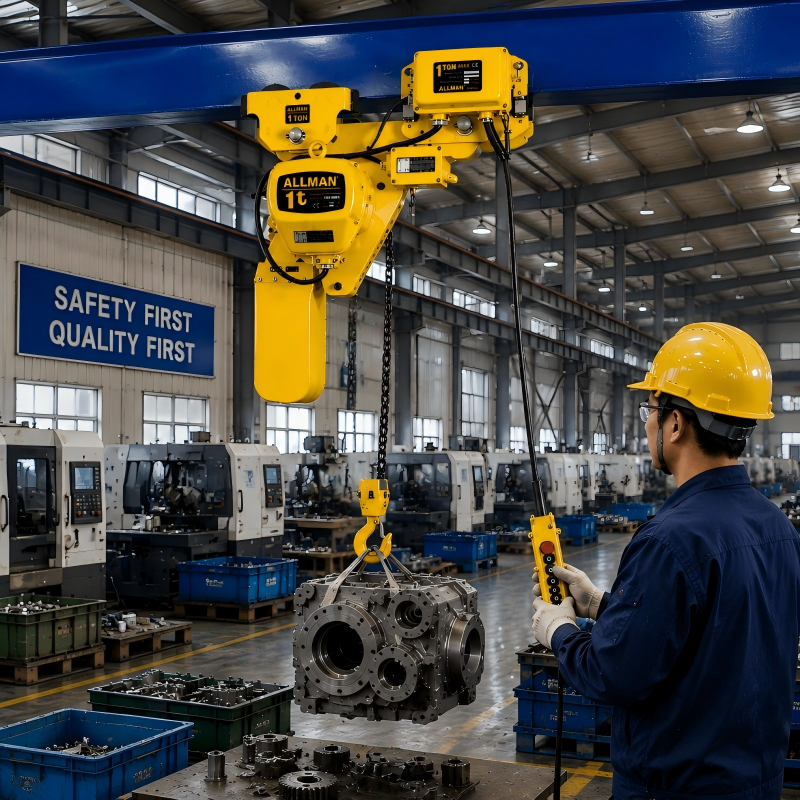
From automotive manufacturing to precision machining, and from the renovation of aging facilities to the construction of new low-ceiling workshops, spatial constraints represent one of the most common and challenging issues in industrial lifting operations. While electric chain hoists are indispensable in modern industrial production, the physical height of traditional hoists becomes a major obstacle when ceiling clearance is limited.
Automotive Manufacturing and Assembly Lines
Automotive production lines demand highly compact equipment layouts. With workshops densely packed with piping, lighting, and ventilation systems, vertical space for lifting equipment is extremely limited. When standard hoists are installed, the unit often hits the ceiling before the hook reaches the required position, drastically reducing the effective lifting stroke.
Renovation of Aging Industrial Facilities
Many industrial facilities built in the 20th century have ceiling heights of only 3.5 to 4.5 meters. Installing conventional hoists results in insufficient effective lifting height, making it impossible to lift large machine tools or equipment units to the required level. Raising the roof or relocating to a new facility entails exorbitant costs, making such options unrealistic for most enterprises.
Mining and Heavy Industry
Operations involve limited underground space, harsh environments, and the need for frequent equipment adjustments. Equipment must be reliable while capable of performing lifting tasks within confined areas.
Precision Manufacturing and Electronics Assembly
Facilities for precision manufacturing, electronics assembly, and mechanical finishing often face issues such as low ceilings, dense equipment layouts, and cramped working spaces. Standard hoists either cannot be installed at all or leave virtually no usable lifting height once in place.
Warehousing and Logistics
In warehouses and logistics centers, vertical space is often dominated by racking systems, leaving very little room for lifting equipment. Traditional hoists are bulky and consume significant vertical space; installing them further compresses an already limited working area. Common issues with traditional electric hoists in these scenarios:
Excessive hoist body height makes installation impossible in low-ceiling facilities.
Even if installed, the effective lifting height is severely limited; the hook hits structural obstructions before reaching the top.
Significant operational blind spots exist, drastically reducing workshop space utilization.
Interference with piping, lighting, and other facilities creates safety hazards.
The cost of facility renovation or relocation is prohibitively high for many enterprises.
These issues directly result in constrained production efficiency, equipment inoperability, significant wasted space, and increased safety risks—ultimately impacting the enterprise's production capacity and profits.
II. Customer Pain Points: Are you facing these issues?
Scenario 1: Renovating older facilities—"Regret after installation"
"Our factory ceiling is only 3.8 meters high. After finally installing the hoist, we discovered the hook couldn't rise high enough to lift even moderately sized workpieces. Raising the roof? The cost estimate made it cheaper to just build a new facility."
This is a real dilemma faced by many small and medium-sized manufacturing enterprises. Having purchased equipment that cannot be used is a waste that is even more frustrating than not buying it at all.
Scenario 2: New low-ceiling workshops—"Looked fine on the blueprints, but insufficient after installation"
"When the workshop was designed, the lifting equipment hadn't been selected yet. Once the hoist was purchased and installed, we found the hook hung too close to the floor, leaving insufficient working height."
A disconnect between the design phase and equipment selection is a common issue in new projects. By the time the problem is discovered, it is often too late for modifications.
Scenario 3: Automotive production lines—"Equipment arrived, but there's no room to install it"
"The production line equipment was already in place. When the hoist arrived on-site, we realized that overhead piping and lighting took up so much space that a standard hoist simply wouldn't fit."
Production line layouts are often compact, leaving far less space for lifting equipment than originally anticipated. Scenario 4: Underground Mining Operations—"Space is tight; the equipment just won't fit."
"Underground tunnels have limited headroom; standard hoists are too bulky, leaving even less room for workers to maneuver once installed. This makes operation difficult and hampers efficiency."
Harsh operating environments, such as mines, impose strict requirements on equipment dimensions: the equipment must not only possess sufficient lifting capacity but also fit within confined installation spaces.
III. Product Solution: How the AMS Low-Headroom Electric Chain Hoist Solves These Issues
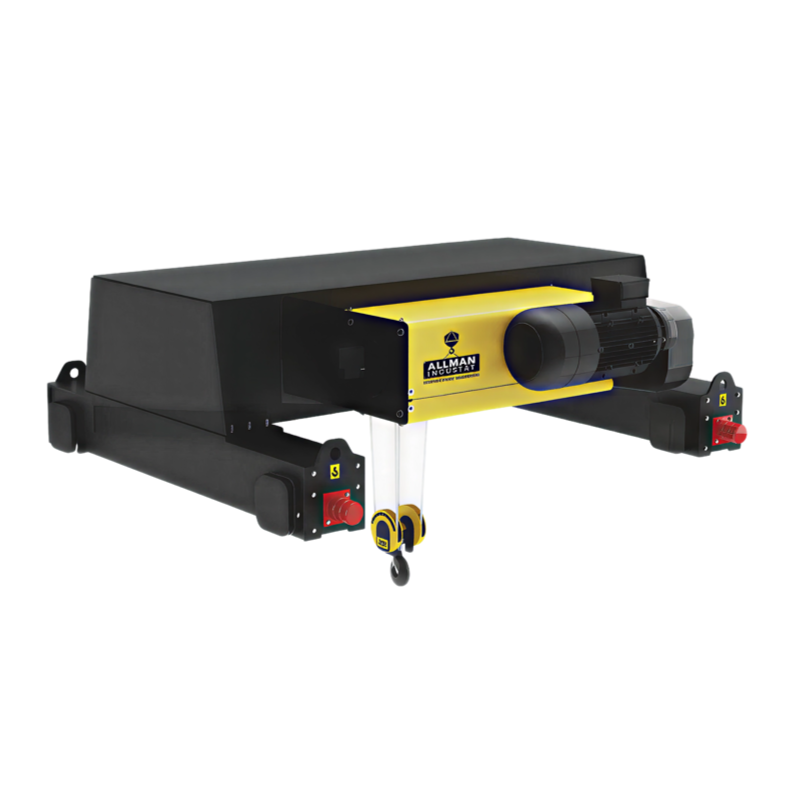
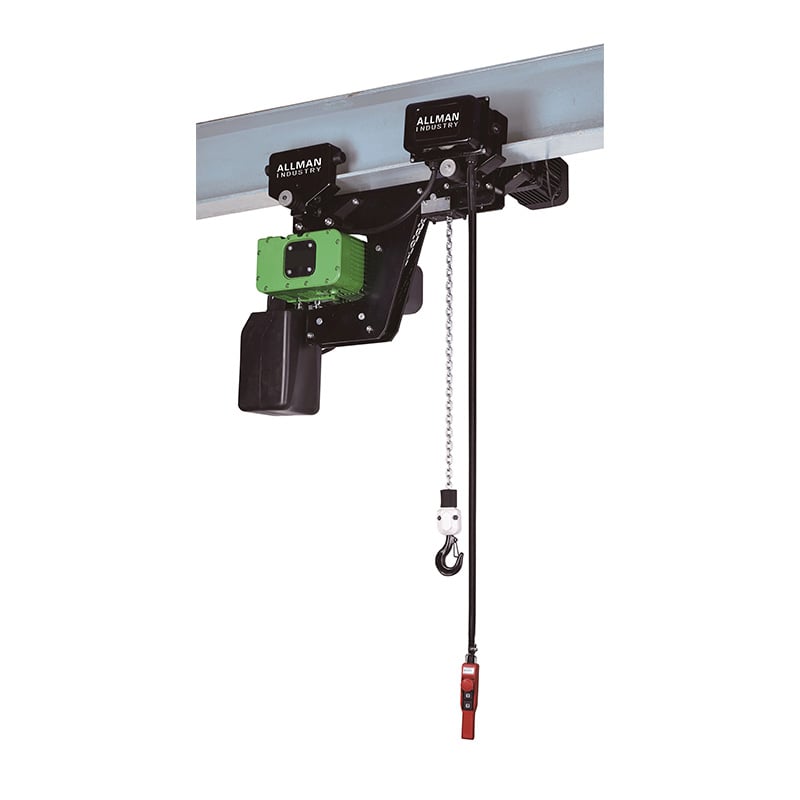
The AMS Low-Headroom Series—Industrial-grade electric chain hoists designed specifically for space-constrained environments.
At the same rail height, the AMS low-headroom hoist provides an additional 200–500 mm of effective lifting space. There is no need to modify the facility or raise the rails; that extra height translates directly into increased productivity.
The Core Principle of Low-Headroom Design
Standard electric hoists utilize a vertical suspension structure where the motor and gearbox are arranged longitudinally—like an upright pillar—consuming significant vertical space. In contrast, the AMS low-headroom series optimizes the connection between the hoist body and the trolley, integrating them onto the same horizontal plane to drastically reduce the unit's overall height. The hook can rise to a position just below the rail, minimizing the gap between the hoist body and the overhead beam; this maximizes the effective lifting stroke within the existing facility height.
By "reclaiming" overhead space, the AMS low-headroom series allows you to achieve maximum effective lifting height within the constraints of your facility. Core Specifications
Parameter | AMS Low-Headroom Series Specs | Industry Value
Duty Class | M5 | Meets demands for high-frequency, continuous operation
Protection Class | IP55 | Fully dust-tight and resistant to low-pressure water jets; suitable for harsh environments
Cooling System | Equipped with cooling fan | Prevents overheating during continuous operation; extends motor lifespan
Contactor | Eaton contactor | Top-tier international electrical component; stable and reliable
Braking System | Electromagnetic brake | Instant braking upon power loss; millisecond response; ensures safety
Insulation Class | Class F | Higher heat resistance; longer service life
Certifications | CE, ISO 9001 | Guaranteed quality; meets international standards
Five Core Advantages
✅ 1. Ultra-low headroom design—Maximize vertical space on existing tracks
By optimizing the connection structure between the hoist body and the trolley, the AMS low-headroom series minimizes the unit's overall height. Compared to standard electric hoists, the effective lifting height is increased by 200–500 mm. For low-ceiling workshops (3.5–4.5 meters), those extra centimeters make the difference between being able to perform a lift and not being able to do so at all.
✅ 2. M5 high duty class—Built for high-frequency demands
The M5 duty class is an international standard rating designed for "frequent lifting and continuous operation" scenarios. Whether it involves hundreds of lifts daily on an automotive production line, frequent maintenance of underground mining equipment, or continuous logistics operations, the AMS handles it with ease.
✅ 3. IP55 high protection rating—Resilient in harsh environments
IP55 certification signifies complete protection against dust and resistance to low-pressure water jets from any direction. The AMS operates reliably in diverse conditions—from the cleanliness requirements of precision workshops and the dusty environments of mines to the humid conditions of foundries.
✅ 4. Efficient heat dissipation design—Stays cool during continuous operation
Equipped with an independent cooling fan that provides continuous airflow to the motor. Compared to standard hoists without fans, the AMS maintains better control over temperature rise during prolonged, continuous operation, resulting in a longer motor lifespan. ✅ 5. Reliable Electrical and Braking Systems – Dual Safety Assurance
Equipped with Eaton brand contactors and top-tier international electrical components, the system features highly anti-welding contacts capable of withstanding frequent start-stop cycles. The electromagnetic braking system employs a "fail-safe" design—whether the control button is released or a sudden power outage occurs, the brake engages instantly to prevent heavy loads from falling. An F-class insulation system ensures the motor operates reliably even in high-temperature environments.
IV. Application Value: What Can the AMS Low-Headroom Hoist Bring to Your Industry?
Renovation of Older Factory Facilities
Applicable Scenarios:
Equipment upgrades in older workshops with ceiling heights of 3.5–4.5 meters
Retrofitting projects where no space was originally reserved for lifting equipment
Factories needing to increase lifting capacity without relocating
Value Delivered by AMS:
Increases effective lifting height by 200–500mm via direct installation—no need to raise the roof or replace the facility
Compact structure meets installation requirements for low-clearance spaces
M5 duty rating ensures continuous operation during high-frequency usage
IP55 protection rating suits the dusty and humid environments often found in older workshops
Automotive Manufacturing and Assembly Lines
Applicable Scenarios:
Lifting components on automotive production lines
Mold changing and equipment maintenance
Handling large components such as engines and vehicle bodies
Value Delivered by AMS:
Low-headroom design avoids overhead obstructions like piping and lighting fixtures
M5 duty rating meets the high-frequency lifting demands of production lines
Eaton contactors ensure electrical reliability during frequent start-stop operations
Electromagnetic braking guarantees precise positioning and operational safety
Mining and Heavy Industry
Applicable Scenarios:
Lifting and maintenance of underground equipment
Lifting operations in confined spaces
Maintenance of mining machinery Hoisting
Value provided by AMS:
Low-headroom design suits the confined spaces found underground
IP55 protection rating withstands dusty and humid mining environments
M5 duty rating ensures capability for 24-hour continuous operation
Equipped with a cooling fan to handle high-temperature mining conditions
Precision Manufacturing & Electronics Assembly
Applications:
Installation and maintenance of precision equipment
Material handling on electronics assembly lines
Lifting operations within cleanrooms
Value provided by AMS:
Low-headroom design maximizes lifting height within limited ceiling clearance
IP55 protection rating meets cleanroom dust-prevention standards
Electromagnetic brake ensures stable, precise positioning of sensitive equipment
Compact structure saves valuable workshop space
Warehousing & Logistics
Applications:
Loading and unloading of heavy goods in warehouses
Equipment installation in logistics centers
In-factory material handling
Value provided by AMS:
Low-headroom design fits into the tight spaces between warehouse racks
High-frequency operation capability meets the continuous demands of logistics centers
IP55 protection rating suits dusty warehouse environments
Compact structure allows for flexible operation amidst dense racking layouts
Why Choose ALLMAN?
✅ Ultra-low headroom design increases effective lifting height by 200–500mm
✅ M5 high duty rating supports high-frequency, continuous operation
✅ IP55 high protection rating withstands harsh environments (dust, humidity, etc.)
✅ Eaton brand contactors—top-tier international electrical components
✅ Electromagnetic braking system ensures immediate, safe, and reliable braking upon power loss
✅ Independent cooling fan prevents overheating during continuous operation
✅ CE certified and ISO 9001 quality management system compliant
✅ Over 20 years of experience in lifting equipment manufacturing
✅ 1-year warranty + lifetime technical support
✅ OEM customization available (logo, color, specifications, etc.)
VI. Take Action Now: Choose the AMS Low-Headroom Series to Maximize Productivity in Limited Spaces
Whether you are retrofitting an old factory, upgrading an automotive production line, tackling harsh mining conditions, or optimizing warehousing and logistics efficiency, the AMS low-headroom electric chain hoist delivers an efficient, reliable, and safe lifting solution. Get AMS Low-Headroom Solutions
To obtain the AMS low-headroom product catalog, technical drawings, or a custom quote, please contact us.
Email: [email protected]
WhatsApp: +86 13817585870
Every inquiry gets a reply. Every customer gets a test certificate.
Nantong Allman Industry Co.,Ltd. is a professional manufacturer specializing in the manufacturing and export of high-quality lifting&material handling equipment in China.
Room 1503, Building#2, No.#166, North Street, Nantong City, Jiangsu Province, China.
Copyright © Nantong Allman Industry Co.,Ltd. All Rights Reserved Privacy Policy Blog