EN
EN
The Challenge: Why Lifting Operations Fail When You Need Them Most
In manufacturing and industrial environments, lifting equipment is often the silent backbone of production. When it works, no one notices. When it fails, everything stops.
Yet most companies continue to use hoists that were never designed for their actual working conditions:
Automotive assembly lines push hoists to their limits with hundreds of lifts per shift
Foundries expose hoists to extreme heat, dust, and corrosive particles daily
Steel and metal fabrication plants require precise control under heavy loads
Maintenance workshops need versatile hoists that can handle multiple tasks
The result? Frequent breakdowns, production delays, and a growing maintenance backlog that drains resources and morale.
What if your hoist could keep pace with your production—instead of holding it back?
The Problems You Already Know Too Well
"We've had to replace our hoist three times in five years."
If your hoist is failing within 2-3 years, the total cost of ownership is far higher than the purchase price. Factor in downtime, lost production, and labor costs for repairs, and the financial impact compounds significantly.
"The motor shuts down when we need it most."
Thermal shutdowns often happen at the worst possible moment—during peak production or when the heaviest lift is needed. This is not just an inconvenience; it is a failure of design.
"We cannot get precise positioning."
For applications requiring accurate load placement, a hoist that lacks smooth control leads to wasted time, increased risk of damage, and operator frustration. Every lift becomes a compromise between speed and safety.
"The chain wears out too quickly."
Chain wear is often the first sign of inadequate duty rating. If your chain is wearing out before the scheduled maintenance interval, the hoist is being asked to do more than it was designed for.
The AMS Solution: Engineered for the Realities of Industrial Lifting
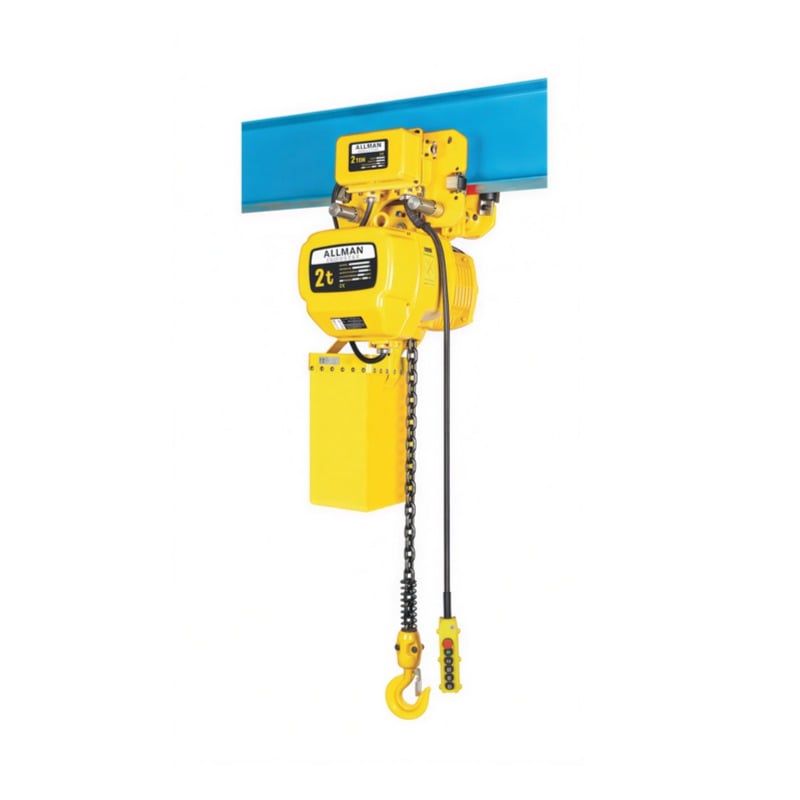
The AMS Series is not a "one-size-fits-all" product. It is specifically designed for industrial environments where standard equipment falls short.
Core Configuration
Parameter AMS Series
Duty Classification :M5 (12,500 hours of service life)
Protection Rating :IP55 (dust-tight and protected against water jets)
Motor :TEFC motor with integrated cooling fan and shroud
Brake :Electromagnetic brake (engages on power loss)
Overload Protection Friction clutch: (slips automatically under overload)
Chain :Grade 80 alloy steel chain
Limit Switches :Dual limit switches (upper and lower travel limits)
Design :Low-headroom, compact construction
Five Critical Features That Make the Difference
1. Thermal Resilience — Continuous Operation Without Overheating
The AMS motor is equipped with an engineered cooling fan and shroud, ensuring efficient airflow to dissipate heat from both the motor and brake. With a duty rating of up to 360 starts per hour, the AMS maintains consistent performance even in high-temperature environments.
What this means for you: No unexpected thermal shutdowns. No waiting for the motor to cool. Your production keeps moving.
2. Instant, Fail-Safe Braking
The electromagnetic brake engages immediately when power is cut, stopping the load in place and holding it securely. The brake is rated for over 1 million cycles, providing confidence that your hoist will respond correctly in every situation—including emergencies.
What this means for you: Your load stays where you put it. Your operators stay safe. Your liability is minimized.
3. Built to Outlast the Competition
Every AMS hoist is subjected to 100% load testing before shipment, with test results linked to a unique serial number. This is not an inspection check—it is a demonstration of what the hoist can actually do, ensuring that what you ordered is what you receive.
What this means for you: No surprises when you put the hoist into service. You know exactly what you are getting, and you know it has been proven before it arrives at your facility.
4. Grade 80 Chain — A Higher Standard of Durability
The Grade 80 alloy steel chain offers breaking strength that is significantly higher than standard chains, along with superior wear resistance and fatigue resistance. This extends service intervals and reduces the total cost of ownership.
What this means for you: Fewer chain replacements. Less maintenance time. Lower operating costs over the long term.
5. Compact, Low-Headroom Design
By optimizing the connection between the hoist body and the trolley, the AMS achieves a significantly lower overall height compared to standard hoists.
What this means for you: In the same track height, the AMS provides an additional 15 to 30 centimeters of effective lifting space.
Nantong Allman Industry Co.,Ltd. is a professional manufacturer specializing in the manufacturing and export of high-quality lifting&material handling equipment in China.
Room 1503, Building#2, No.#166, North Street, Nantong City, Jiangsu Province, China.
Copyright © Nantong Allman Industry Co.,Ltd. All Rights Reserved Privacy Policy Blog