EN
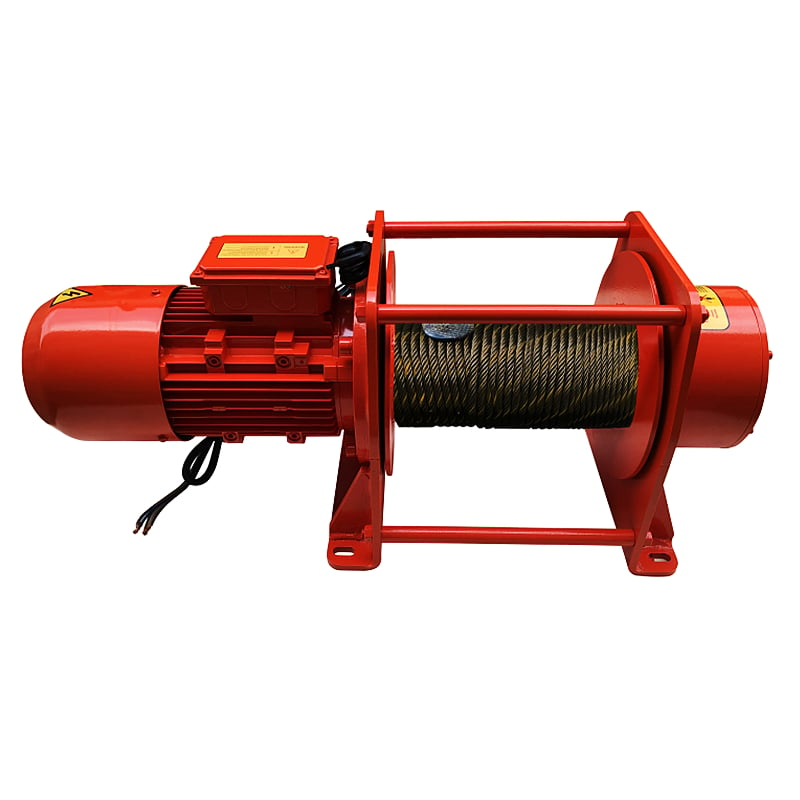
AMWE electric winches stand on the same dispatch line, in the same orange livery, built on the same drum-and-frame architecture. Look at the electrical end and they are different machines. One carries a built-in variable frequency drive with its own keypad on the enclosure. The other is a conventional contactor-controlled unit with a finned motor and a plain terminal box.
Both are production units, photographed before crating.
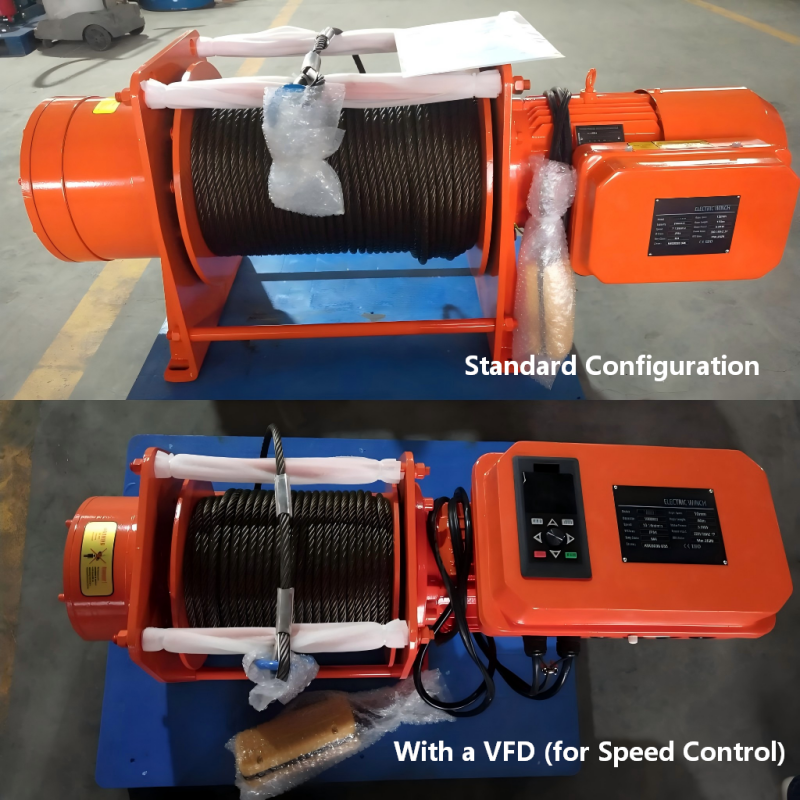
The drive is not a control gimmick. It changes how the motor behaves, and that changes what the operator can do with the load.
It regulates speed continuously. A conventional winch runs at the speed the motor and gearbox give it — one figure, or two if the motor is wound for two speeds. A drive takes the incoming supply, rectifies it and synthesises a three-phase output at whatever frequency is selected, so the drum speed becomes a parameter rather than a fixed consequence. The speed band is printed on the nameplate as a range, because the working speed is set at commissioning to suit the job.
It starts and stops softly. Under direct-on-line starting the motor pulls a multiple of its rated current the instant the contactor closes, and the drum steps to full torque at once. The drive instead ramps voltage and frequency together, so the winch accelerates over a controlled interval: lower starting current, and far less shock loaded into the wire rope, the drum, the gearbox and the anchor point. The same applies on the way down — deceleration on a ramp, not a sudden stop.
It raises the safety margin in three ways.
Less load swing: Most load movement at the end of a lift comes from abrupt deceleration, not from the pull itself. Ramping the stop keeps the load where the operator put it.
Inching: Slow, deliberate rope travel lets an operator bring a load down onto a mark, or past an obstruction, at walking pace instead of at full speed.
A settable ceiling on speed: The maximum frequency can be capped on site, so a winch cannot be run faster than the installation is rated for — useful where different crews share the machine.
A drive of this class also monitors its own electrical conditions — overcurrent, overvoltage, phase loss — and trips before those conditions damage the motor.
The conventional machine is not the lesser product, and it is the correct choice for the majority of work.
It covers most jobs without asking anything of the site. Outdoor construction, general hauling, pulling, lifting raw material and shifting equipment — the ordinary duty of a winch on a building site, in a yard, or on a service truck — needs a motor that pulls, not a motor that is tuned. A standard unit does that with no parameter list, no keypad to learn, and no drive to keep cool.
It suits hard outdoor conditions. Construction sites are dusty, vibratory and electrically rough. A finned motor and a contactor are tolerant of that environment, and there is no electronics enclosure to shade, no firmware to reload after a supply disturbance, and nothing to re-commission after a long idle season.
It is cheaper to buy, wire and keep. No drive means no drive cost, a smaller enclosure, and a fault diagnosis that a site electrician can make with a meter. Where a winch runs one direction under load all day, the extra control buys nothing.
Where the winch only has to pull, specify the standard unit. Where the load has to arrive at a particular place, at a particular speed, or stop without swinging, specify the drive.
Both units share the same drum and grooved rope lay, the same reduction gearbox, the same brake at the drive end, and mounting feet on a fabricated frame. Both are rated IP54 and M4 — a duty class for intermittent working, not continuous production. Both carry an ALLMAN INDUSTRY plate with capacity, rope length, speed, supply and serial number engraved per order, alongside CE and ISO marking.
Frame, colour and mounting pattern are identical. Drive, motor enclosure and control philosophy are not — and that difference is a specification decision, not a cosmetic one.
The two versions are quoted from the same short list. Send us these and the drive question usually settles itself:
Load— the weight to be lifted or pulled, and whether the winch is lifting vertically or dragging horizontally;
Application— what the machine does all day, and how many starts per hour;
Rope length— the travel you need, and how much rope you want on the drum;
Speed— the lifting speed you need, or the cycle time you have to hit;
Power supply— phases, voltage and frequency at the site;
Mounting — how the winch will be fixed: floor, wall, mast or vehicle;
Environment— indoor or outdoor, dust, moisture, coastal air, ambient temperature;
Control— pendant, remote, or integration into an existing panel.
 Hot News
2026-07-11
2026-07-02
2026-07-01
2026-07-03
2026-06-12
2026-01-23
Nantong Allman Industry Co.,Ltd. is a professional manufacturer specializing in the manufacturing and export of high-quality lifting&material handling equipment in China.
Room 1503, Building#2, No.#166, North Street, Nantong City, Jiangsu Province, China.
Copyright © Nantong Allman Industry Co.,Ltd. All Rights Reserved Privacy Policy Blog