EN
Most hoist enquiries arrive as a single number: "I need a 2-tonne hoist." That number decides almost nothing. Below is the order in which the specification actually has to be settled, using the AMEH series as the worked example.
The AMEH is designed to FEM 9.511 class 1Am — ISO M4. That rating is not a marketing tier; it is a life budget, and how you load the machine decides how fast you spend it. The manual sorts duty into four load levels — from light to overweight:
|
Load level |
Duty pattern |
|
1 — Light |
Mostly light loads, maximum load only in exceptional cases |
|
2 — Medium |
Mostly light, maximum load at low frequency |
|
3 — Heavy |
Frequently medium and heavy loads |
|
4 — Overweight |
Frequently at or near maximum load |
Your daily operating hours then map onto a service-life band (1Bm through 5m). The practical rule for buyers: the same 2-tonne hoist that lasts years on level 1 duty can be the wrong machine on level 4 duty at the same hours. Declare the duty pattern up front — it is the single question that most changes the answer.
|
Working load limit |
Chain diameter |
Chain pitch |
|
0.3 t / 0.5 t |
φ6.3 mm |
19 mm |
|
1 t / 2 t / 3 t |
φ7.1 mm |
21 mm |
|
1.5 t / 2 t |
φ10.0 mm |
30 mm |
|
2.5 t – 25 t |
φ11.2 mm |
34 mm |
Note that the series runs from 0.3 t to 25 t. Also note that 2 t appears at two chain sizes: the same rated capacity can be built on different chain depending on the number of falls and the lifting height. When comparing quotes for "2 tonne", ask which chain spec is inside — a φ7.1 machine and a φ10.0 machine are not the same purchase.
Single speed suits hauling and repetitive transfer; dual speed gives a slow approach for positioning and a fast return for cycle time. Choose from the work, not from the price: if the load must stop within centimetres — assembly, mould handling, unloading finished parts — specify dual speed at the quotation stage. Retrofitting it later means changing the motor and the control circuit.
The AMEH series is designed for operation in an ambient temperature range of -20 °C to +40 °C, with a relative humidity not exceeding 85%. Both the hoist unit and the push-button control station carry an IP54 ingress protection rating. Please ensure the following points are confirmed before signing a contract:
AMEH accepts 3-phase, 210–690 V, 50/60 Hz. If your site has a weak feed, long cable runs or a generator, that is a specification input, not an installation detail.
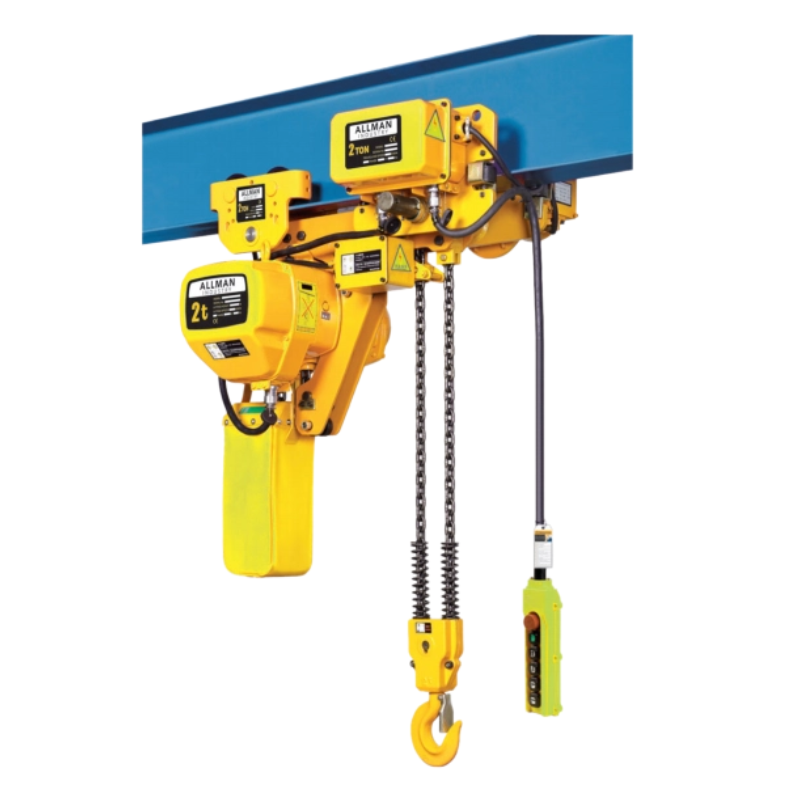
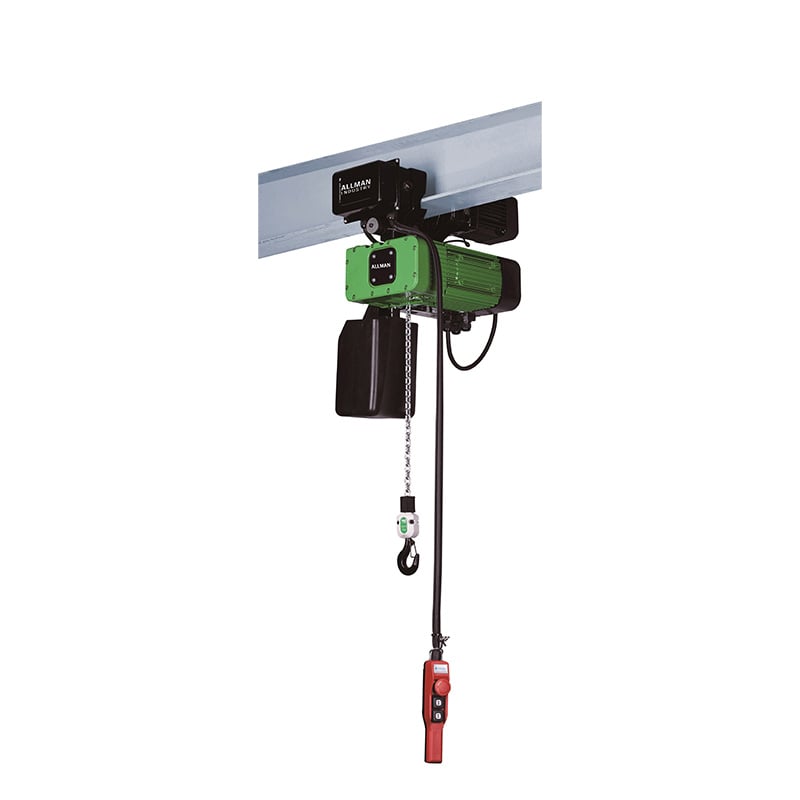
If a trolley is specified, two dimensions decide whether it will actually work on your beam:
Also check the lifting geometry: sling angle must stay within 120°. Beyond 120° the hook is being pulled sideways.
|
Check |
Acceptance value |
|
Brake — hook drift after release |
Within 2–3 chain links |
|
Hook mouth opening "a" |
0.5 t: 27 mm ` 1 t: 34 mm ` 2 t: 46 mm ` 3 t: 56 mm ` 5 t: 67 mm ` 10 t: 82 mm ` 15 t: 110 mm ` 25 t: 142 mm |
|
Chain spring length |
φ6.3 & φ7.1: 145 mm (limit 140) ` φ10.0: 135 mm (limit 129) ` φ11.2: 160 mm (limit 152) |
|
Earth resistance |
Below 100 Ω |
|
Limit switch |
Motor stops automatically at both upper and lower limit |
|
Chain eye welding points |
All facing the same direction |
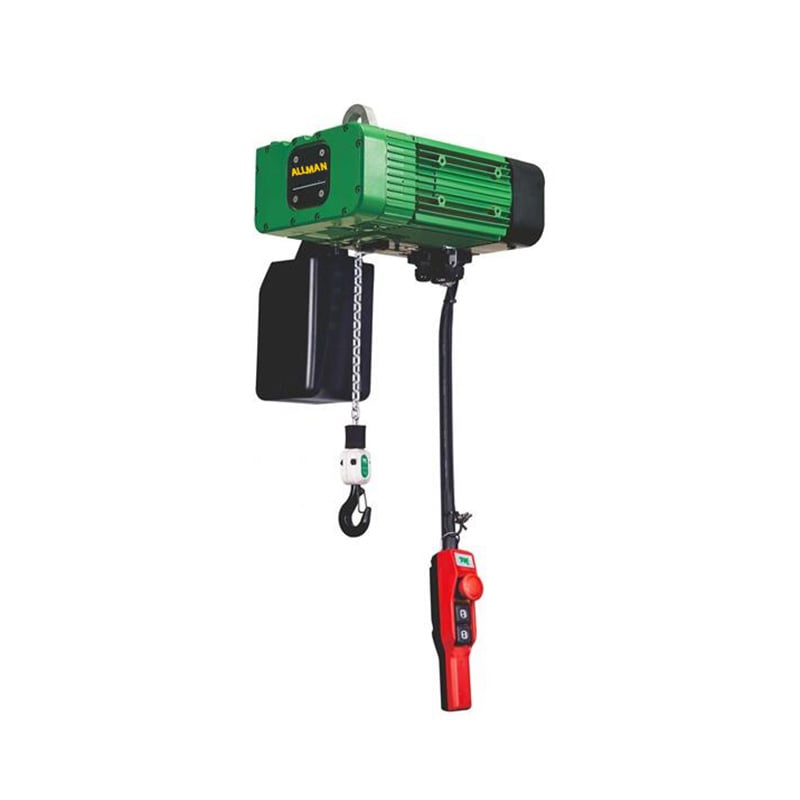
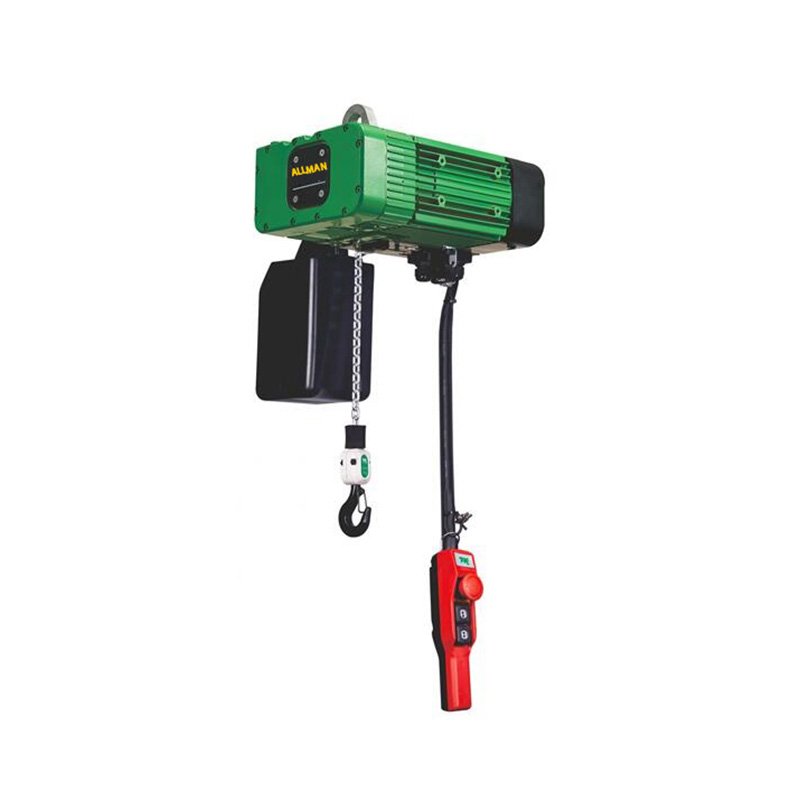
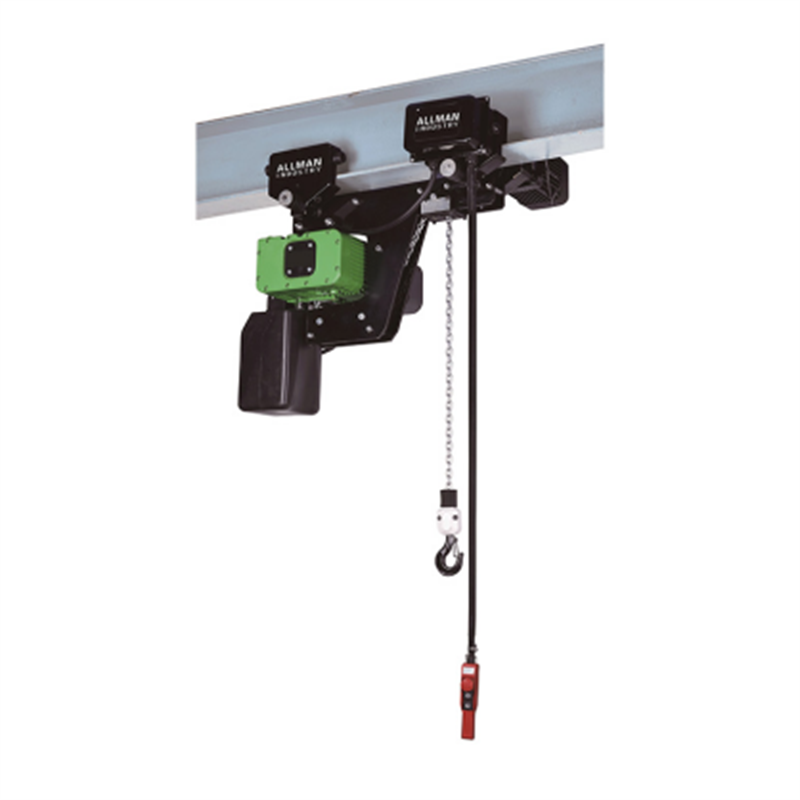
The control pendant for the ALLMAN electric chain hoist features buttons for up, down, left, and right movement, as well as an emergency stop button and an "ON" button. Although the lifting chain is lubricated at the factory, the lubricant may dry out during transit; therefore, it should be re-lubricated during the commissioning phase. Additionally, a small amount of lubricant should be added to the chain bag. The necessary lubricant is included in the wooden crate along with the electric chain hoist.
1. Load to be lifted, and the load spectrum (which of the four levels)
2. Lifting height
3. Single or dual speed
4. Hook suspension, manual trolley or electric trolley — plus rail flange width if a trolley
5. Site voltage, frequency and phase
6. Ambient temperature and humidity, and whether the site is wet, outdoor or corrosive
Send those six and the model, the chain spec and the control configuration follow without a second round of questions. Omit them, and the cheapest quote you receive is usually the one that has to be replaced first.
Feel free to reach out for a price quote at any time.
 Hot News
2026-07-11
2026-07-02
2026-07-01
2026-07-03
2026-06-12
2026-01-23
Nantong Allman Industry Co.,Ltd. is a professional manufacturer specializing in the manufacturing and export of high-quality lifting&material handling equipment in China.
Room 1503, Building#2, No.#166, North Street, Nantong City, Jiangsu Province, China.
Copyright © Nantong Allman Industry Co.,Ltd. All Rights Reserved Privacy Policy Blog