EN
Most electric-winch enquiries open with three numbers: capacity, rope length, speed. Those are also the three the factory has already solved — they sit on the datasheet, they are easy to compare, and on a well-built machine they are rarely what goes wrong.
Electric winches fail at the interfaces: the six places where the machine meets the world around it. None appear on a datasheet, all are decisions the buyer makes, and every one can be got wrong on a perfectly good winch.
|
Model |
Capacity |
Line speed (50 Hz) |
Motor |
|
AMW-E500 |
500 kg |
13–19 m/min |
1.5 kW |
|
AMW-E1000 |
1000 kg |
13–19 m/min |
3.0 kW |
|
AMW-E2000 |
2000 kg |
13–19 m/min |
5.5 kW |
|
AMW-E3000 |
3000 kg |
8–14 m/min |
7.5 kW |
|
AMW-E5000 |
5000 kg |
8–14 m/min |
15 kW |
Speeds are stated at 50 Hz; at 60 Hz expect roughly 20% more. Rated capacity is stated for lifting duty — treat any other duty as a separate specification, not a bonus.
The rope. DIN 3060 construction, 1770 MPa nominal tensile strength, fibre core: 6×19+FC through 2000 kg, 6×37+FC for 3000 kg and above. Rope diameter is matched to capacity — ask for it in writing with the offer, because it also determines the sheave and hook block you will need.
This is where the money is lost, and it is decided before the winch is ordered.
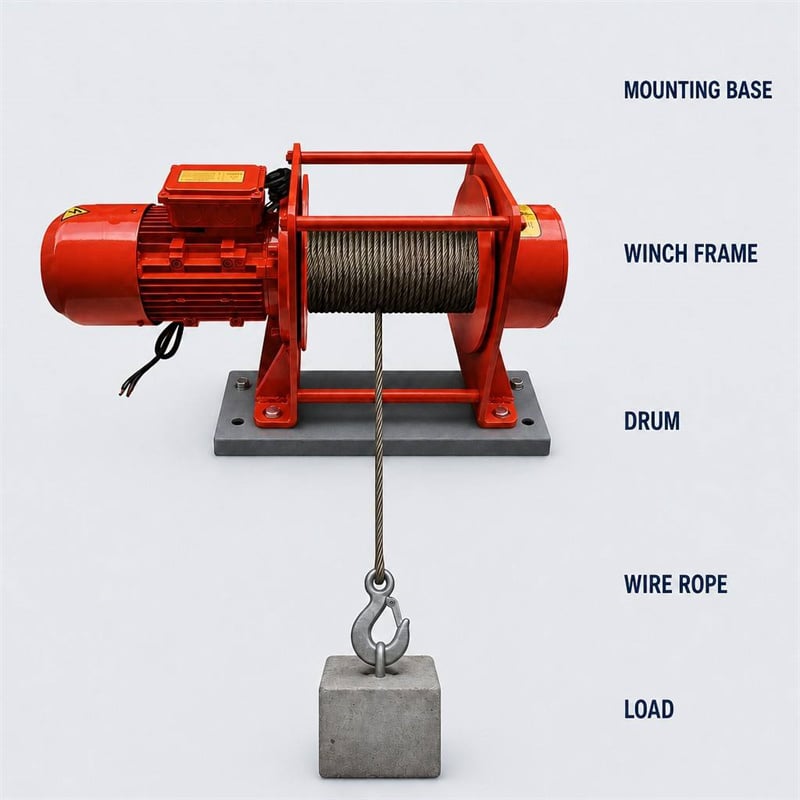
The mounting structure must be designed by an engineer to withstand the forces the winch produces at rated load — not the weight of the winch, the forces it generates. Under-specify the frame and the symptom appears elsewhere: inadequate alignment, support or attachment leads to loss of efficiency or premature failure of the winch, the rope, or the mounting base itself.
Two rules follow: mount on flat, solid, level ground so the machine cannot move while working, and get the bolt pattern before you fabricate.
The commonest installation error, and the cheapest to fix on paper.
The winch must be centred on the drum and perpendicular to the pulling direction, and the fleet angle θ must not exceed 2°.
Why 2° and not 10°: exceed it and the rope spools unevenly, piling to one side. The rope then rubs the side plate, layers cross and crush each other, and the line of action walks along the drum axis while you pull. Each of those shortens rope life and moves the operator closer to a failure than the datasheet suggests.
This is a layout decision — set it at drawing stage, then check it again once the machine is bolted down. A frame that is "close enough" is the usual way a 2° figure becomes 6°.
Five wraps minimum remain on the drum at all times, backing up the rope clamp. The clamp anchors the rope end; it is not designed to carry the working load alone.
Leave 1 m unwound when you first spool the rope on.
Spool it properly the first time: leather gloves, light tension on the rope, and a second person guiding it so it lays evenly. Rope wound on slack will crush itself under the first real load and never lay flat again. Replace rope on any sign of wear, kinks, rust or broken strands — the check is visual, daily, and takes seconds.
Electrical failures on winches are almost always supply problems wearing a component's clothing.
Wiring correct, the winch runs in the direction of the control switch. Running the other way means reversed phases — fix it at the supply, do not just use the other button.
The pendant is a "dead man" type: release it and motion stops. Confirm that before the first load, not during it.
For a 60 Hz destination, note the speed change at quotation stage rather than discovering it at commissioning.
The one interface designed for field adjustment, which makes it worth understanding whatever brand you buy.
The AMW-E brake is an electromagnetic disc brake at the rear of the motor, released electrically and applied mechanically — loss of power means it brakes, not that the load falls. Its health is one number: the axial free space of the fan brake wheel, normally about 2.5-3 mm(We have already adjusted this gap before it leaves the factory.).
When braking slip increases: remove the motor wind hood, loosen the screw, turn the adjustable lock nut clockwise 1–2 scales, re-tighten the screw, then run a brake test. Repeat if needed.
Two causes of slip are not adjustment problems and must be found first: water, oil, dust or metal shards on the friction surface, all of which reduce friction and can score the disc. A brake that responds late is not merely inconvenient — late response accelerates wear and can overheat and burn the coil.
Pendant at a convenient height above the operating floor; winch positioned so the operator can move and stay clear of the load. Keep everyone else at least 1.5 times the rope length away — rope can fail without warning. Do not install where the hook can be lowered past its rated travel in normal use.
One constraint shapes the whole project: these units are for stationary use only. Any external force on a winch that is not fixed in place can exceed its rated capacity.
1. Load to be moved — lifted, pulled horizontally, or dragged up an incline
2. Rope length required
3. Speed you need, and why (cycle time, positioning accuracy)
4. Mounting: floor or structure, plus the frame drawing if one exists
5. Available space, and the fleet angle you can achieve
6. Supply voltage, phase and frequency
7. Duty cycle: how often, how heavy, how many hours a day
8. Destination environment and market — temperature, humidity, salt, dust, certification
Answer those eight and a winch quotation becomes a specification. Leave them out and it is a price.
 Hot News
2026-07-11
2026-07-02
2026-07-01
2026-07-03
2026-06-12
2026-01-23
Nantong Allman Industry Co.,Ltd. is a professional manufacturer specializing in the manufacturing and export of high-quality lifting&material handling equipment in China.
Room 1503, Building#2, No.#166, North Street, Nantong City, Jiangsu Province, China.
Copyright © Nantong Allman Industry Co.,Ltd. All Rights Reserved Privacy Policy Blog