EN
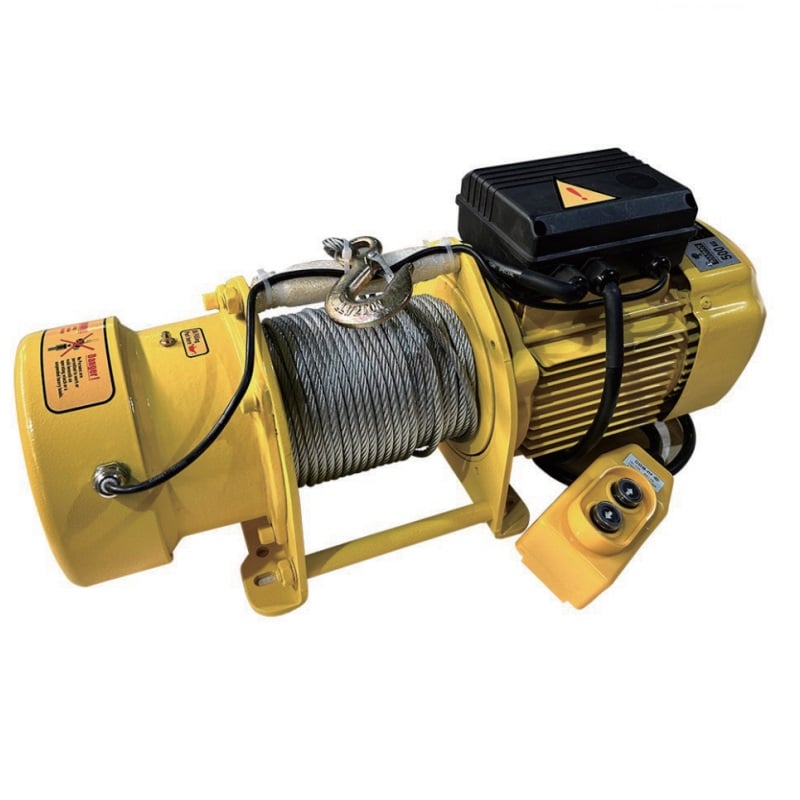
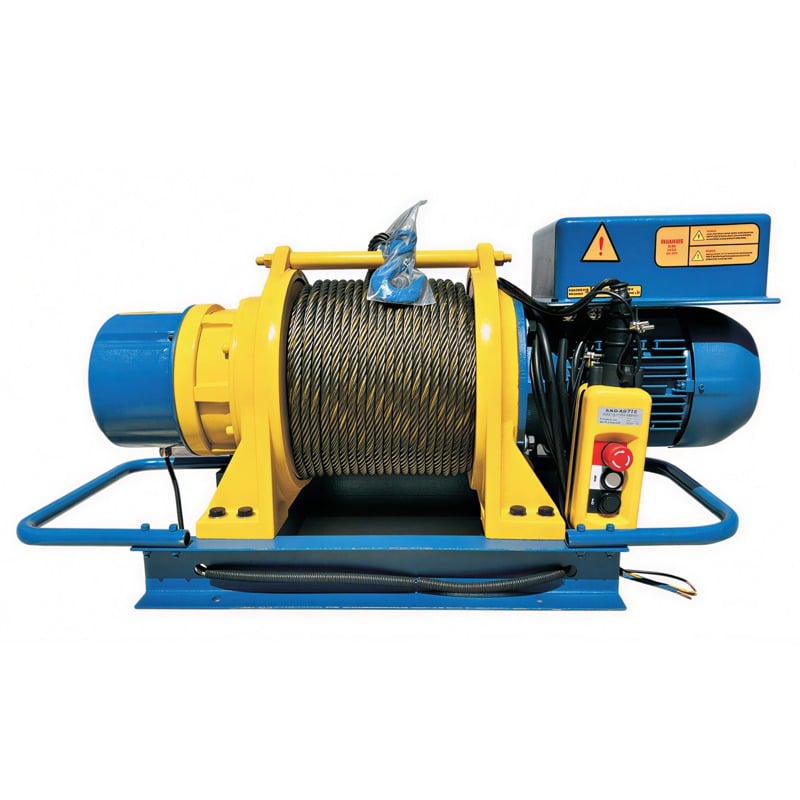
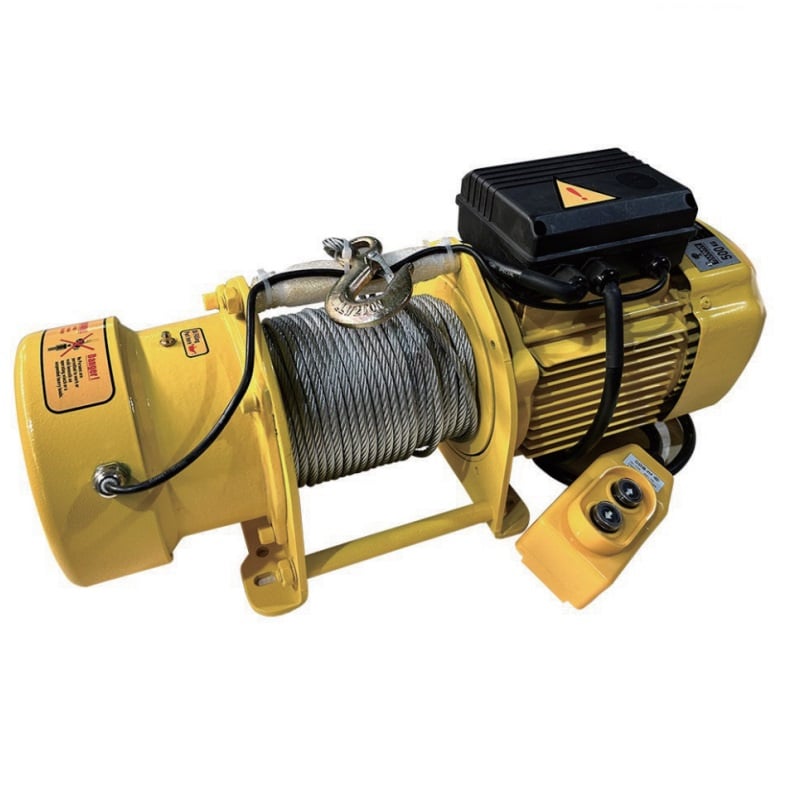
"Electric winch heavy duty" is the most over-used phrase in lifting catalogue and the least verified. Two machines can look identical in a product photo — same red frame, same rope drum, same pendant — and still be rated for completely different workloads. The difference is never in the photograph. It is in five lines of the data sheet.
This article walks through those five lines using a real production winch as the worked example, so you can read any catalogue the same way.
In Europe, powered lifting equipment is covered by EN 14492:
EN 14492-1— power-driven winches: pulling, towing, hauling, dragging along a surface or at an angle.
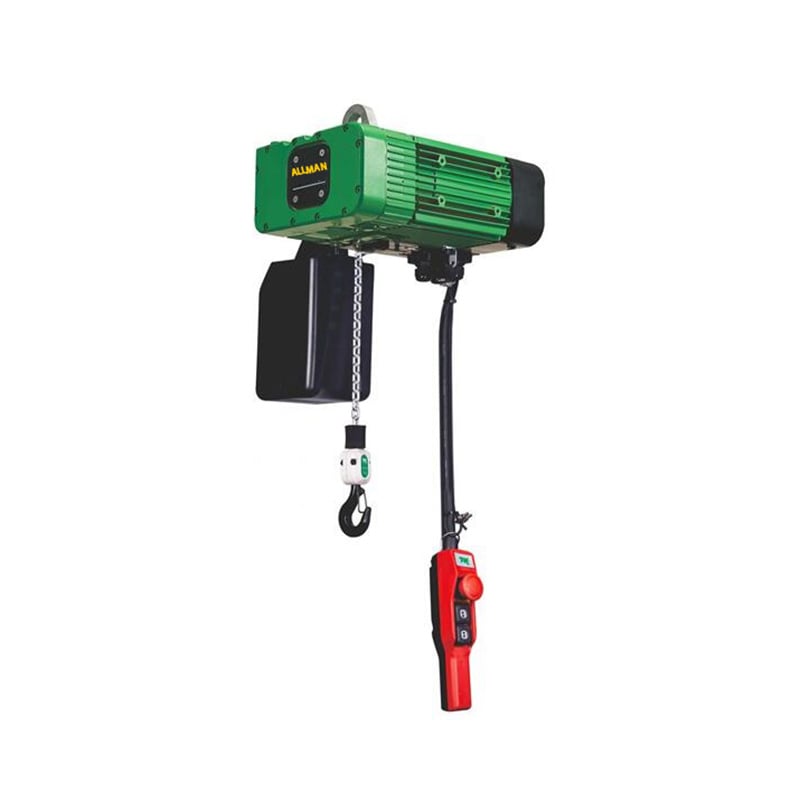
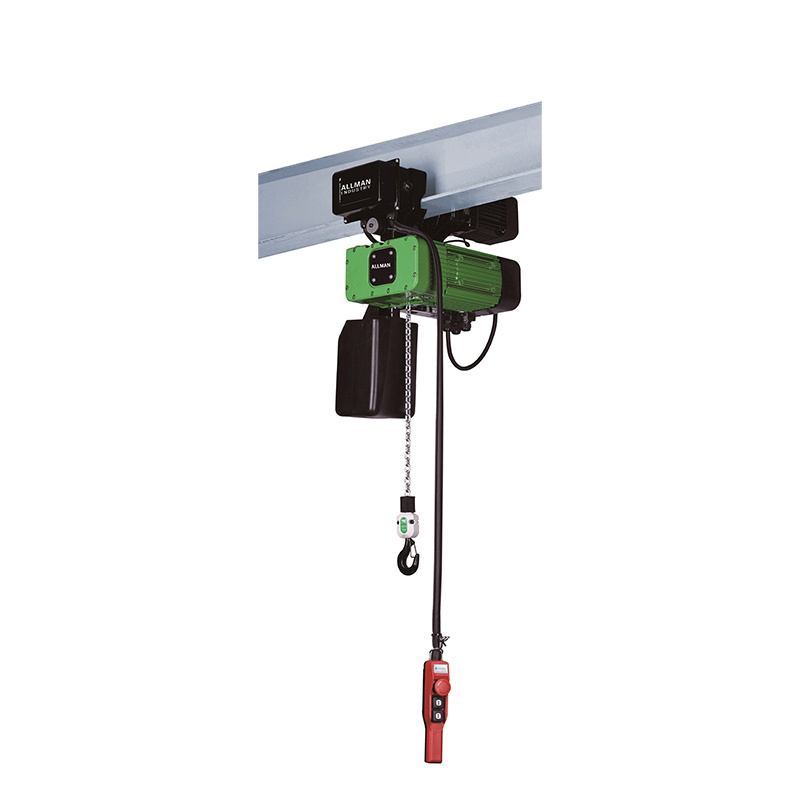
EN 14492-2— power-driven hoists: vertical lifting with rope or chain.
An electric winch pulls. A hoist lifts. The load path — horizontal tension versus a suspended vertical load — determines how the brake, drum and frame are engineered. A winch is not a hoist with a different badge, and using one as the other invalidates the rating.
Capacity is quoted at the first rope layer, where rope sits closest to the drum axis. Add layers and the effective radius grows, so the same motor produces less pull. A 5 t winch rated on layer one is not a 5 t winch on layer three.
Specify from the layer you will actually work in, and keep the working rope length inside the layer band where capacity still meets the job.
This is where "heavy duty" stops being an adjective:
M class (ISO 4301 / FEM) — M1 to M8, derived from load spectrum × total working hours. It describes how much work the machine may accumulate over its life.
ED% — the percentage of a ten-minute window the motor is energised. A 50% ED motor runs half of each cycle; 25% ED units must rest much longer.
On the ALLMAN AMW-E range the rating is explicit: working classification M4, duty rating 50% ED, available in single speed or with an inverter. That is a genuinely continuous-capable rating for medium loads — not a light-duty machine with heavy-duty marketing.
Fast speeds suit hauling and recovery; slow, controlled speeds suit positioning. AMW-E spans 7–13 m/min on the 2 t–3 t models, 9–16 m/min on the 5 t, and 10–14 m/min on the 0.5 t–1 t models — deliberately slower as capacity rises, because moving a heavier load quickly is not a selling point, it is a risk.
Look for two separate numbers, not one: Winch enclosure: IP54 on AMW-E — dust-protected and splash-resistant, applicable outdoors.
Push-button control: IP65 — the pendant is where operators actually stand, often in rain and spray.
Also confirm ambient limits: AMW-E is rated −20 °C to +40 °C, 85% RH or less. A machine specified outside its ambient band fails early regardless of duty class.
AMW-E accepts 220–525 V, 50/60 Hz, three-phase, with 24 V / 36 V / 48 V control voltage and Class F motor insulation. Wide input range matters for export orders — a 415 V/50 Hz site and a 440 V/60 Hz site need different motor windings for the same mechanical rating, and that cannot be fixed at the panel.
|
Model |
Capacity |
Rope length |
Speed (m/min) |
Motor |
Rope Ø |
|
AMW-E500-M |
0.5 t |
≤100 m |
10–14 |
1.5 kW (2.0 hp) |
7 mm |
|
AMW-E500-L |
0.5 t |
101–200 m |
10–14 |
1.5 kW (2.0 hp) |
7 mm |
|
AMW-E1000-M |
1 t |
≤100 m |
10–14 |
3.0 kW (4.1 hp) |
10 mm |
|
AMW-E1000-L |
1 t |
101–200 m |
10–14 |
3.0 kW (4.1 hp) |
10 mm |
|
AMW-E2000-M |
2 t |
≤100 m |
7–13 |
5.5 kW (7.5 hp) |
13 mm |
|
AMW-E2000-L |
2 t |
101–200 m |
7–13 |
5.5 kW (7.5 hp) |
13 mm |
|
AMW-E3000E-M |
3 t |
≤100 m |
7–13 |
7.5 kW (10.2 hp) |
16 mm |
|
AMW-E3000E-L |
3 t |
101–200 m |
7–13 |
7.5 kW (10.2 hp) |
16 mm |
|
AMW-E5000E-M |
5 t |
≤100 m |
9–16 |
15.0 kW (20.4 hp) |
18 mm |
|
AMW-E5000E-L |
5 t |
101–200 m |
9–16 |
15.0 kW (20.4 hp) |
18 mm |
If your duty profile exceeds M4/50% ED, ALLMAN also builds a separate heavy-duty class range (AMW-S) — the right move is to change series, not to run a machine outside its classification.
Bolt through the frame's foot-mounting holes into a pad or structural steel sized for
breakaway load , not running load.
Keep the fleet angle small: a rope pulling hard against the drum flange spools over itself and damages rope and drum together.
Keep 3–5 dead wraps on the drum at all times — the rope anchor alone cannot carry working load.
Position the pendant so the emergency stop is reachable from where the operator actually stands.
Q: What makes an electric winch "heavy duty"?
A: A published duty class. Demand the M classification and the ED% figure. Without them, "heavy duty" is only a word on a brochure.
Q: Is M4 enough for continuous work?
A: M4 with 50% ED covers sustained medium-load work — for example 3,200 hours at moderate load or 1,600 hours at heavy load. Beyond that column, step up a class.
Q: Can I mount AMW-E outdoors?
A: Yes — IP54 enclosure and a −20 °C to +40 °C ambient rating support outdoor installation. For coastal or wash-down sites, specify the stainless steel rope option and review the coating system.
Q: Single speed or inverter?
A: Single speed suits hauling and recovery. The inverter option (also 50% ED on AMW-E) gives soft starts and controlled positioning, which matters when the load must stop within centimetres.
Q: Why does the price differ so much between suppliers for the same 5 t?
A: Usually the drum, the rope grade and the gear system. A Q345 seamless drum and 1770 MPa rope cost more than a fabricated drum and commercial-grade rope — and they are what survive layer three.
Read capacity on the right rope layer, read the duty class before the price, and confirm protection and voltage against the actual site. A winch chosen that way does not need the word "heavy duty" to prove itself.
Send us four numbers — load, pull direction or incline, rope length, and site voltage — and our engineers will confirm the allman electric winch model, its M classification and its rope package in writing.
Nantong Allman Industry Co.,Ltd. is a professional manufacturer specializing in the manufacturing and export of high-quality lifting&material handling equipment in China.
Room 1503, Building#2, No.#166, North Street, Nantong City, Jiangsu Province, China.
Copyright © Nantong Allman Industry Co.,Ltd. All Rights Reserved Privacy Policy Blog