EN
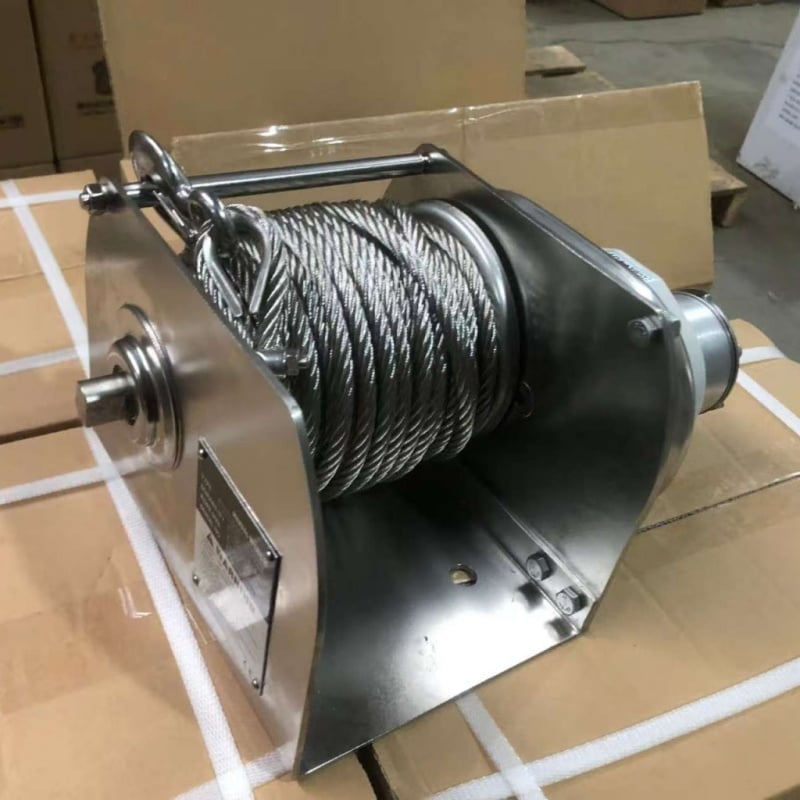
Most winch failures in wet, salty or chemical environments do not start with a broken gear. They start with a chip in the paint. The PNW removes that failure mode entirely — full stainless construction on a hand-powered winch rated up to 1,000 kg.
Walk along any working jetty and you can date the winches by their rust. A painted steel winch mounted outdoors looks fine for the first season. Then a rope rubs the coating off a side plate, a bolt head loses its plating, and the first brown streak appears. Two years later the drum is pitted, the crank shaft is stiff, and someone is sanding and repainting a piece of equipment that was supposed to need no attention at all.
The PNW is our answer to that lifecycle. It is a hand winch built in full stainless steel — side plates, drum, shaft, fasteners and rope — with no paint film to damage and no zinc plating to turn white. Where a painted winch has a surface that can fail, the PNW has material all the way through.
Corrosion on a coated winch is rarely uniform. It starts at the places where the coating is interrupted, and those places are exactly where the winch works hardest:
Rope contact. Every pass of the wire rope across a guide or a drum flange wears the paint thin. That is the first rust point, and it is hidden under the rope.
Fastener heads. Plated bolts in a stainless or aluminium assembly are the classic galvanic couple. The bolt corrodes first, seizes, and then cannot be removed for service.
Chemical splash. Chlorine in a pool plant, hypochlorite in a water treatment room, fertiliser dust in an ag-chemical store, acid mist around a plating line — each of these attacks a paint film from the edges inward.
Salt and wash-down. A jetty winch gets salt spray on the outside and fresh water from a hose on the inside. Salt trapped behind a mounting plate does not dry out, so the corrosion continues out of sight.
Fish, food and pharma plants. Here the problem is not only corrosion but hygiene: flaking paint and rust staining are contamination risks, and a painted winch in a wash-down area creates a maintenance job that never ends.
For a lift that happens a few times a day, a hand winch is often the more reliable machine, not the cheaper compromise:
No electrical supply to provide. No cable run, no local isolator, no electrician on installation day.
Nothing electrical to fail. No motor winding, no capacitor, no control box, no IP rating to inspect after a storm.
Works wet. Splash, spray and rain are not an operational problem — which is precisely the environment where an electric unit needs an enclosure and a maintenance regime.
Silent and controllable. The operator feels the load through the crank, which is useful when pulling against something that might suddenly break free.
Portable and simple to mount. Four bolts on a base plate and the winch is in service.
The trade-off is honest: a hand winch is limited by how much one person can crank. That is why the winch stops at 1 tonne rather than pretending to compete with a powered drum.
Click here to contact us for more detailed information.
 Hot News
2026-07-11
2026-07-02
2026-07-01
2026-07-03
2026-06-12
2026-01-23
Nantong Allman Industry Co.,Ltd. is a professional manufacturer specializing in the manufacturing and export of high-quality lifting&material handling equipment in China.
Room 1503, Building#2, No.#166, North Street, Nantong City, Jiangsu Province, China.
Copyright © Nantong Allman Industry Co.,Ltd. All Rights Reserved Privacy Policy Blog