EN
Every electric winch has a moment where the load goes from still to moving. On a conventional direct-on-line winch, that moment is abrupt: the contactor closes, the motor draws its full starting current, and the drum takes up slack in a fraction of a second. The rope snaps taut, the frame absorbs the shock, and the operator learns to expect the jolt.
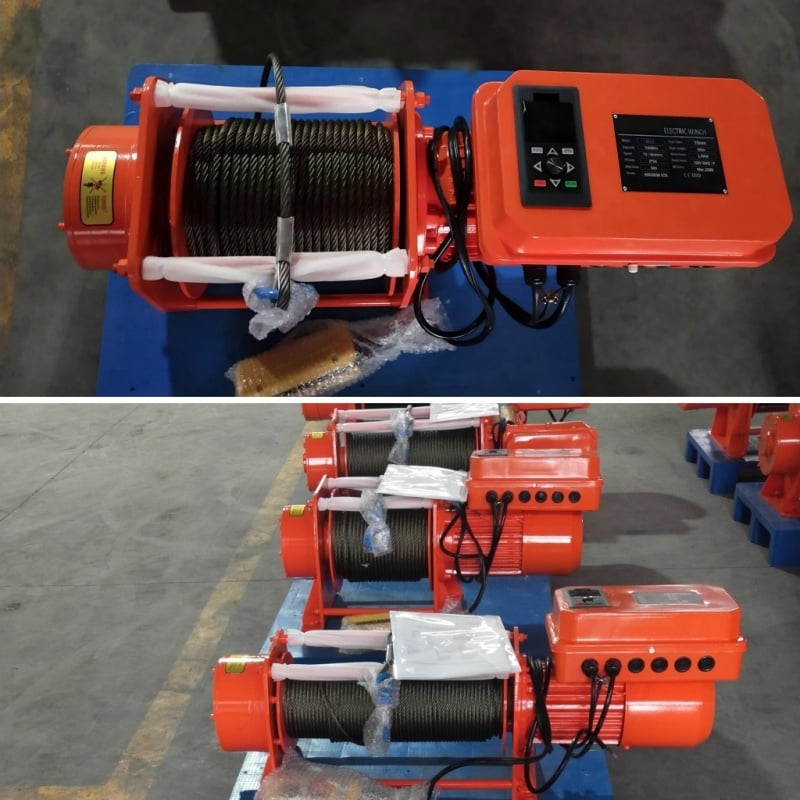
On the AMWE, that moment has been customizably redesigned. The winch now carries an integrated variable frequency drive (VFD) in the control box, which ramps the motor up to speed instead of switching it on at full torque. The result is the effect operators describe simply as a soft start — and it changes more than the first half-second of a lift.
Soft starting is often sold as a comfort feature. In practice it addresses three failure modes that show up in every winch service log:
1. The rope snatch
When a hook takes up load instantly, the wire rope absorbs a dynamic force well above the static weight. That spike is what flattens strands against the drum, crushes the crossover points in the spooling, and eventually produces the broken wires inspectors look for. Ramping the torque over a controlled interval keeps the peak load close to the rated load, so the rope sees a smooth tension curve instead of a step change.
2. The starting current spike
A direct-on-line start pulls several times the running current for the first cycles. On a weak supply — a long extension run, a small generator, a shared site distribution board — that spike trips breakers and dims lights. The VFD limits current during acceleration, which makes the same motor far easier to live with on an ordinary 220V single-phase supply.
3. Load swing and bad spotting
Off-centre loads are the classic cause of a swinging hook. Start and stop the drum in hard steps and the load keeps moving after the drum has stopped. With a controlled ramp on both ends, the load walks to a stop instead of snapping into place — which is what makes precise positioning possible at low speed.
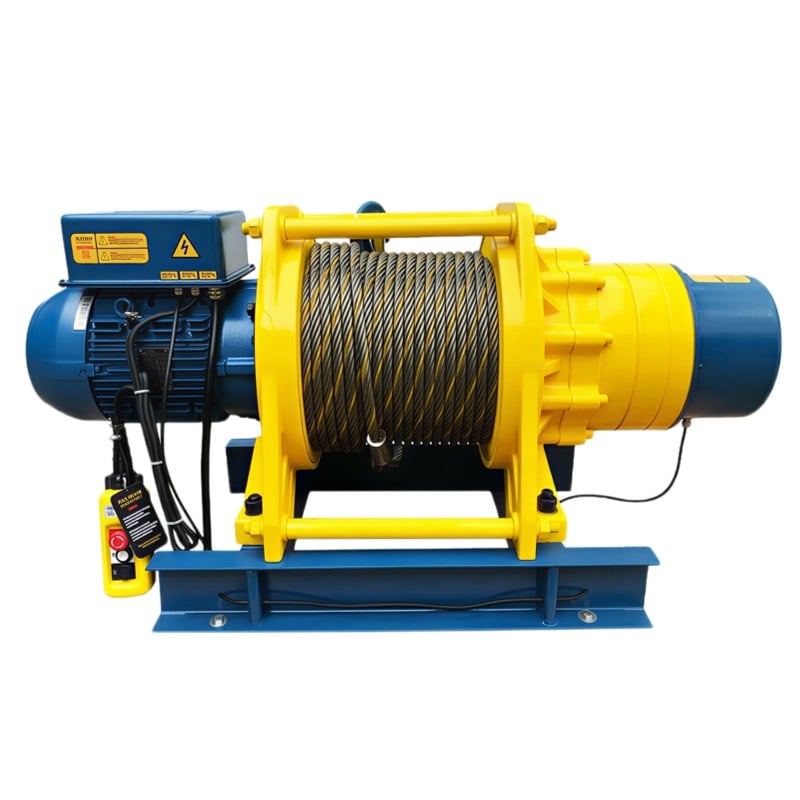
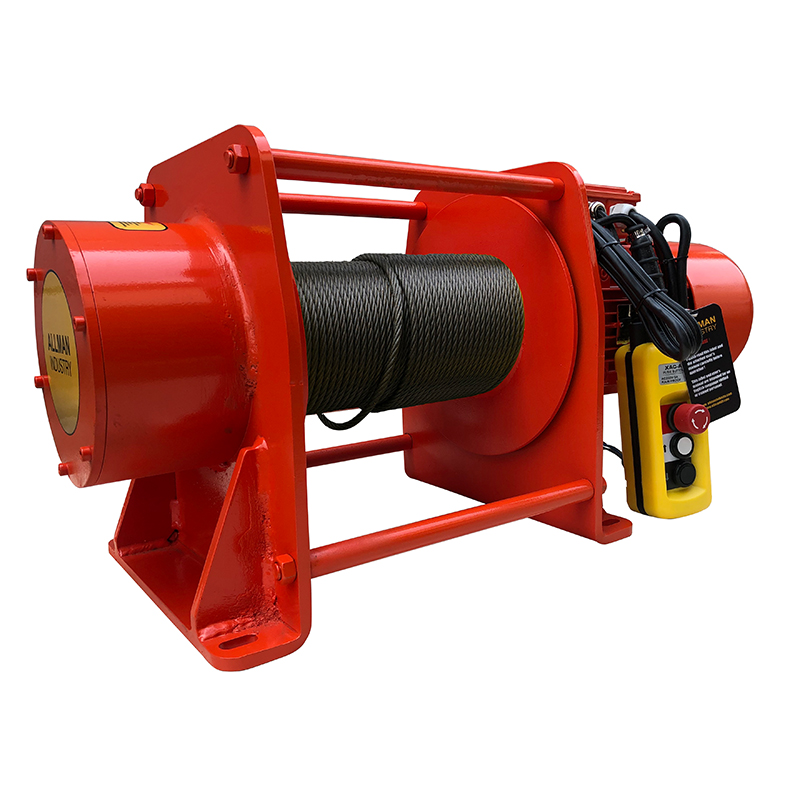
The AMWE electric winch is built to order around the duty, not the other way round. Beyond the build shown above, we regularly supply:
Three-phase 380V and 60Hz variants for markets with different supply standards.
Higher capacities and longer drum capacities to suit the rope length required.
Wireless remote control, with pendant or panel operation retained.
Stainless steel wire rope and stainless or galvanized hardware for coastal and wash-down environments.
Custom drum grooving, mounting frames and paint colors to match a fleet.
Q: What is the difference between a VFD winch and a two-speed winch?
A: A VFD winch allows speed adjustment within its designed operating range, providing greater flexibility. A two-speed winch uses a motor with two preset speeds, making operation simpler when only fast and slow speeds are required. The best option depends on the application and control requirements.
Q: Does a VFD increase the price of an electric winch?
A: Yes, adding a VFD may increase the total price because of the drive, electrical control components, and additional configuration requirements. The final cost depends on motor power, speed range, control functions, and whether the VFD is integrated into the control cabinet.
Q: Can a VFD electric winch operate at both high and low speeds?
A: Yes. A VFD can provide adjustable speeds within the system's designed operating range. The available speed range depends on the motor, gearbox, cooling requirements, and load conditions. Please specify your required minimum and maximum speeds when requesting a quotation.
Q: Is a VFD electric winch suitable for heavy-duty applications?
A: It can be suitable for heavy-duty applications when the motor, gearbox, brake, VFD, and overall winch are correctly selected for the required load and duty cycle. For frequent operation or demanding working conditions, please provide your expected operating hours and load characteristics.
Q: Can I customize the voltage and frequency of an electric winch?
A: Yes. Voltage and frequency can be configured according to the selected model and application requirements. Please confirm your required voltage, phase, and frequency, such as 380V/50Hz or 440V/60Hz, before ordering.
 Hot News
2026-07-11
2026-07-02
2026-07-01
2026-07-03
2026-06-12
2026-01-23
Nantong Allman Industry Co.,Ltd. is a professional manufacturer specializing in the manufacturing and export of high-quality lifting&material handling equipment in China.
Room 1503, Building#2, No.#166, North Street, Nantong City, Jiangsu Province, China.
Copyright © Nantong Allman Industry Co.,Ltd. All Rights Reserved Privacy Policy Blog