EN
EN
Two 1-Ton Hoists, Two Different Philosophies
Walk into any lifting equipment expo and you will see dozens of electric chain hoists that look almost identical: a yellow aluminum body, a load chain, a pendant. But look inside — at the brake, the gearbox, the speed control — and the differences are anything but cosmetic. Get the selection wrong and you are not saving money; you are buying a future warranty claim, a motor burnout, or a shutdown on your client's production line.
At ALLMAN, our electric chain hoist family is built around two distinctly engineered series — AMEH and ER — each with its own design philosophy, duty rating, and target application. This guide breaks down the 9 differences that matter, explains what each one means for your buying decision, and ends with a practical selection checklist.
Before We Compare: 4 Specs You Need to Understand
The Two Series at a Glance
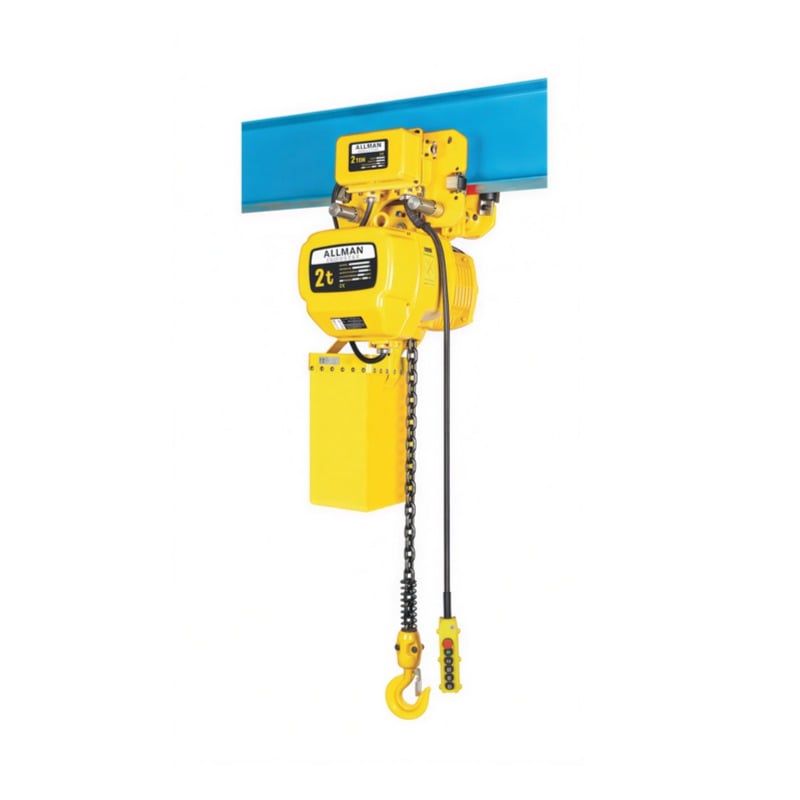
AMEH Series — the universal workhorse. A general-purpose electric chain hoist engineered around a "zero-defect safety architecture": die-cast aluminum housing, high-purity copper-wound motors, and globally standardized spare parts. It is offered as fixed, trolley, and low-headroom types, in single- or dual-speed, and it is a popular choice for crane builders and distributors in emerging markets — ALLMAN also supplies it as SKD kits with OEM branding for local crane manufacturers.
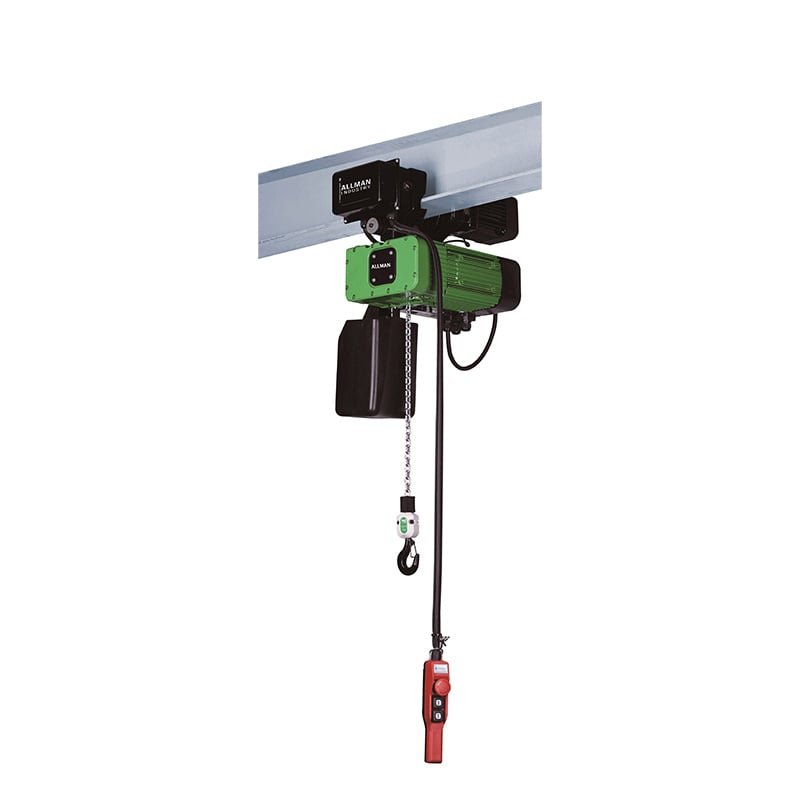
ER Series — the European-style compact. A new-generation, European-style electric chain hoist designed for heavy industrial duty: M5 working class, electromagnetic brake, compact planetary gearing, and an optional built-in inverter for variable-speed lifting. It targets factories, construction sites, mines, and docks where smooth handling and high duty matter.
The 9 Key Differences
| # | Dimension | AMEH Series | ER Series |
| 1 | Design philosophy | Universal / general-purpose | European-style compact (ER2) |
| 2 | Working class | M4 (medium-heavy, FEM 2M / 40% ED) | M5 (heavy duty) |
| 3 | Brake system | Side magnetic brake | Electromagnetic brake (faster response) |
| 4 | Transmission | Precision helical gears, oil-bath lubrication, <80 dB | Compact planetary gear system |
| 5 | Speed control | Single speed standard, dual speed optional | Single speed + optional built-in inverter (VFD) |
| 6 | Overload protection | Dual-stage limit switches + electrical protection | Slipping clutch (mechanical overload protection) |
| 7 | Heat dissipation | Die-cast aluminum fins (≈40% higher dissipation) | Full-aluminum motor frame + dedicated cooling fan |
| 8 | Capacity range | 0.5t–25t (larger on request) | 0.5t–30t, fine-grained multi-fall system (1–12 falls) |
| 9 | Target market | LATAM & emerging markets, crane builders, stockists (SKD/OEM) | European & global industrial applications |
Shared by both series: lightweight aluminum housing, G80 load chain, 24V/36V/48V low-voltage control, CE & ISO 9001 certification, MOQ 1 unit.
1. Design Philosophy — and Why It Matters
AMEH is built like a classic industrial chain hoist: proven, rugged, easy to service with standard components anywhere in the world. ER follows the European school — more compact, more integrated, with the electronics (inverter) packaged into the hoist body. If your customers service their own equipment with locally available parts, AMEH is forgiving; if they buy on technical specification and European design language, ER speaks their language.
2. Working Class: M4 vs M5
This is the difference with the biggest financial consequence. AMEH is rated M4 — ideal for single-shift workshops, warehouses, and intermittent lifting. ER is rated M5, engineered for continuous, high-frequency operation: assembly lines, mining maintenance, docks. A hoist selected below its real duty will overheat, degrade insulation, and fail early. A hoist selected above its duty is money wasted on capacity you never use.
3. Brake: Side Magnetic vs Electromagnetic
The AMEH side magnetic brake is a time-tested design that stops the motor quickly and holds the load reliably. The ER electromagnetic brake responds even faster and is characteristic of European-style hoists — an advantage for precise positioning and frequent stop/start cycles. For heavy, high-cycle work, the faster brake response also means less load swing and better operator control.
4. Speed Control: The Inverter Question
Standard AMEH hoists are single-speed with dual-speed as an option — simple, robust, economical. ER takes it a step further: an optional built-in inverter gives smooth, variable-speed lifting, which matters when you are lowering expensive loads, positioning heavy components, or running automated cycles. If your application needs soft starts and precise inching, ER's VFD option is the differentiator.
5. Overload Protection: Electrical vs Mechanical
AMEH protects the hoist with dual-stage limit switches plus electrical safeguards (including reverse-phase protection that locks the control circuit if the 3-phase supply is wired incorrectly). ER adds a slipping clutch — a mechanical overload device that slips under excessive load before components can be damaged. Mechanical and electrical protection are complementary: the clutch covers the physical shock, the electronics cover mis-wiring and over-travel.
7. Heat Dissipation
Both series fight heat — the number-one enemy of motor life. AMEH's die-cast aluminum body with cooling fins improves heat dissipation by roughly 40%, supporting sustained duty in poorly ventilated workshops. ER pairs a full-aluminum motor frame with a dedicated cooling fan, extending runtime in heavy-duty cycles. Same goal, two proven solutions.
8. Positioning and Target Market
AMEH is deliberately positioned for crane builders, stockists, and distributors — especially in Latin America and emerging markets — with SKD kit supply, custom OEM branding, and color matching as standard services. ER targets buyers who specify European-style hoists for industrial plants, often with inverter and certification requirements. Your own sales channel should mirror this: volume distributors vs. technical spec-driven projects.
Which One Should You Choose?
1. Choose AMEH when:
Budget sensitivity and low cost of ownership matter most;
2. Choose ER when:
5-Question Selection Checklist
Before you ask for a quote, answer these:
1. Duty:
How many lifts per hour, and how many hours per day? (M4 or M5?)
2. Capacity:
What is the heaviest load — and is it a single fall or do you need a double/triple fall arrangement?
3. Lift height:
Standard 3 m, or custom up to 30 m?
4. Power:
What voltage and frequency does the site have? (AMEH: 3P 220–690 V, 50/60 Hz; ER: 220–525 V, 50/60 Hz, 3-phase)
5. Environment:
Indoor, semi-outdoor, dusty, or coastal? (IP54 standard, IP55 and corrosion-resistant chain options available)
FAQ
Q: Is M5 always worth the extra cost over M4?
A: Only if your duty demands it. M5 buys you higher thermal capacity and a heavier work allowance — essential for continuous operation, wasted on intermittent light use. Match the class to the actual duty, not the price tag.
Q: Do I really need an inverter on a chain hoist?
A: For most lifting — no. For precision positioning, soft start/stop, or frequent load handling, a VFD pays for itself in reduced load swing and component wear. ER offers it as an option, so you are never forced to pay for it.
Q: Can ER hoists be supplied with my brand?
A: Yes. Both series support OEM branding — custom labels, laser-etched nameplates, and housing colors — and AMEH is additionally available as SKD kits for local crane assembly.
Q: What certifications do these hoists carry?
A: Both AMEH and ER are CE certified with ISO 9001 quality management, and are supplied with test reports and user manuals. Documentation for import and project compliance can be provided on request.
 Hot News
2026-07-11
2026-07-02
2026-07-01
2026-07-03
2026-06-12
2026-01-23
Nantong Allman Industry Co.,Ltd. is a professional manufacturer specializing in the manufacturing and export of high-quality lifting&material handling equipment in China.
Room 1503, Building#2, No.#166, North Street, Nantong City, Jiangsu Province, China.
Copyright © Nantong Allman Industry Co.,Ltd. All Rights Reserved Privacy Policy Blog